

As part of our series on internationally relevant topics by our author Sergey Frank, we are dedicating a three-part article to the extremely important question of how to conduct successful negotiations on the international stage.
Negotiations play an important role in every business, including at the international level, of course, and rarely proceed in a uniform manner. Complex situations often arise internationally, for example due to differences in the language skills of the negotiating parties or diverging cultural and value systems. Discussions usually take place in English or in third languages, often with the assistance of interpreters, as described above. In addition, there are differing priorities and time expectations.
These aspects are complex and harbor considerable risks that can result in misunderstandings, wasted time, and frustration. To prevent this and at the same time improve communication and understanding between the negotiating partners, certain rules of the game must be observed.
These rules include a clear four-step negotiation process: opening and setting the key milestones (part 1), communicating and exploring the interests of the other side (part 2), the actual negotiation (part 3), and agreement and, ideally, conclusion of the contract (part 4). The result of a negotiation may initially only be a partial agreement, before further issues are negotiated in another round. And the process of understanding, listening, and negotiating may also be repeated several times. Especially in people-oriented cultures such as those in the Middle East, Asia, or Russia, negotiations can drag on for a long time.
In many countries, the personal level is perhaps even more important than the factual level. To avoid serious conflicts, it is therefore important to separate the two levels. Often, the partner is not seen as a representative of a company, but as a person. Discontent about an unpleasant situation can lead to this anger being taken out on the other person. To avoid this, it is better to clearly separate relationship elements such as understanding, respect, affection, fear, and anger on the one hand, and factual elements such as prices, specifications, competitive advantages, payment, and delivery terms on the other. You can always negotiate your interests consistently, but at the same time treat your partner politely.
The goal
Personal appreciation and integrity are essential components of any business relationship, whether national or international. In this context, it is impossible to provide a magic formula for successful negotiation at the international level. Furthermore, it is not the intention to teach rhetorical tricks that could potentially "trick" or "cheat" the other party. The following section deals with conscious negotiation, i.e., how to act in a factual, rational, and structured manner. It is in the negotiator's primary interest to
- negotiate effectively and professionally
- avoid ineffective conflicts
- to achieve appropriate results as quickly as possible
- Achieving commitment even in an intercultural context.
After thorough preparation, including a clear definition of what you want to achieve, the actual negotiations can begin. Negotiations generally follow the pattern shown in the diagram below, whereby the process of understanding, listening, and negotiating can be repeated several times. The final contract is often reached in the form of partial agreements.
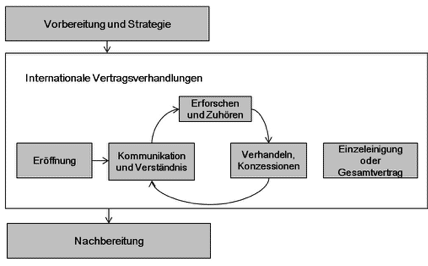
The above illustration clearly shows the overall constellation and also the dynamics of contract negotiations. In principle, these are based on good preparation for negotiations, the achievement of partial agreements, and then the continuation of negotiations. Ultimately, a comprehensive contract is concluded (or not).
It is useful to consider the following points regarding the individual steps:
Preparation
Before the actual negotiations begin, you should try to get to know your partner. The more you know about them, both professionally and personally, the better. It is therefore very important to create a positive atmosphere at the beginning of a negotiation.
Politeness and hospitality are a given in this context. In addition, it is important to show interest in your partner as a person, communicate openly, make friendly eye contact, and, last but not least, use humor. National customs also play a very important role in international negotiations.
It is generally advisable to allow sufficient time for negotiations. Time pressure often leads to negative outcomes. Lack of time is often used as a means of exerting pressure, especially in international negotiations.
If you determine the specific topic for a negotiation in advance, you can assume that the negotiation will proceed as planned and not get out of hand. One way to do this is to divide the topic into main topics, secondary topics, main arguments, and secondary arguments. This structures what may initially appear to be a complex issue and makes it understandable, both for yourself and for your partner. The following points should be noted:
- Agenda – structure the topic of negotiation
- Definition of key terms, because it is often important to define terms precisely, ideally in collaboration with the other party.
- Developing a negotiation strategy and preparing for your own goals, but also reflecting on the priorities of the other side
- Flexibility – searching for options and reconsidering possible concessions
- A step-by-step approach – from smaller to larger issues as negotiations progress
In addition to personal aspects, the procedural approach is also relevant, and a clear structure for the discussion is essential. With regard to the argumentation, care should be taken not to start the negotiation too coldly and soberly. This form of negotiation with high initial positions and negative statements such as "this far and no further" is considered too demanding in many countries. You also risk losing face if you give in to your expectations during the course of the discussions.
It is therefore important not to establish positions that are too high from the outset, but rather appropriate ones. Factors such as saving face and interest in the culture and personality of the other party are generally of great importance. Therefore, negotiate less about positions and more about upstream interests. Those who succeed in summarizing the other party's position and then explaining their own point of view significantly improve their chances of success.
Clear and consistent arguments should be well prepared. This preparation usually takes some time. It is advisable to check the consistency of your own point of view and any changes to it. At the same time, as many options as possible for the negotiation goal and strategy should be developed in advance.
It is equally important to consider the other party's objections, insofar as they are foreseeable, in order to be able to respond quickly and appropriately.
In reality, such preparation is often lacking, especially due to time constraints. The parties usually go into negotiations ill-prepared and with a solution that they believe to be correct and therefore infallible; conflicts are then inevitable.
Please remember: there are few other areas where so much can be gained or lost so quickly as in international negotiations. In the next part, we will focus on the right structure and show how helpful a change of perspective can be in this regard.
To the articleRules for conducting international negotiations (Part 2)
To article Rules for conducting international negotiations (Part 3)