It is not only technical knowledge – such as qualifications, professional experience and industry expertise – that is crucial to successfully performing a role. Above all, soft skills, professional interest, motivations, values and social behaviour must be taken into account.
It has been suggested that successful individuals within a particular occupational group are almost identical in terms of their personality traits and soft skills. Each standard or best-practice profile presents a distinct picture that is typical of the respective occupational group.
The following phenomenon was observed when defining the personality traits of typical area managers:
A well-known car manufacturer had a need for staff in its sales department. This raised the question of how the vacant positions should be filled.
Contrary to the procedure previously followed in personality tests – which involved comparing new candidates with a demographic group or focusing on specific characteristics requested by line managers – a reference profile was drawn up here based on individuals in the same profession. This means that a comparison allows far more meaningful conclusions to be drawn.
To further optimise the process, a best-practice profile has been created, so that it is not merely possible to determine whether a candidate possesses the characteristics required for the role, but also whether they are highly likely to perform successfully.
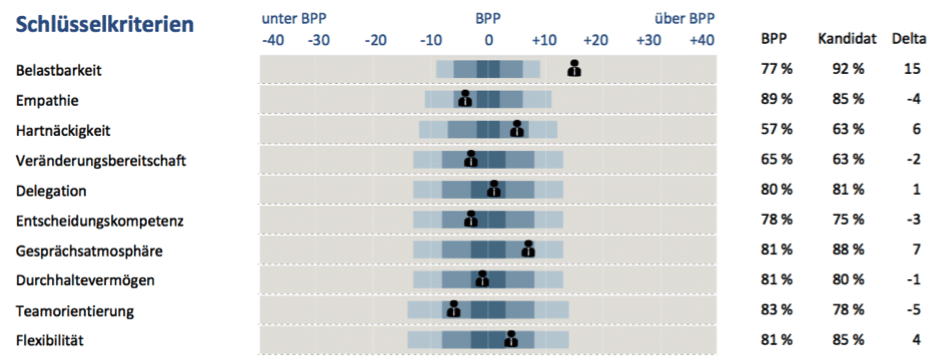
To verify this revolutionary approach, HR Consult Group AG subsequently tested the top 10 per cent of 1,400 sales staff from the same premium car manufacturer and drew up a best-practice profile (BPP). Surprisingly, this BPP was also very clear-cut. The characteristics of the key competencies – and thus the profiles of the best salespeople – are as alike as two peas in a pod, regardless of age, region, ethnic background or regional affiliation.
To obtain further evidence of the validity and success of this approach, the most successful salespeople at another premium car manufacturer were surveyed. The corresponding BPP shows that even the best salespeople at this manufacturer followed an almost identical approach.
An example of an almost identical match across the key criteria can be seen in the following figure:
It is therefore believed – and evidence has been provided to support this – that successful members of a professional group exhibit personality traits that show a high degree of alignment with key competencies. These traits are further highlighted in the best-practice profiles. They represent the personality traits that are actually crucial to professional success.
The gaps between a candidate’s profile and the standard profile can be used to identify and implement staff development needs in the form of training or further education.
The key finding is that the most successful individuals within a particular occupational group are almost identical in terms of their personality traits and soft skills. Each standard or best-practice profile presents a distinct picture that is typical of the respective occupational group.
The next post in this series will explain how to create a best-practice profile.
After completing his degree in Automotive Engineering and Industrial Engineering, he began his career in the automotive industry in the fields of sales, development and marketing, and also spent a year in Japan working for one of the largest automotive suppliers.
He then moved to a world-renowned premium car manufacturer, where he served as a marketing officer responsible for product marketing in Japan and South America, and as a marketing officer responsible for marketing strategy in North and South America.
In 1994, he decided to set up his own business and founded a recruitment consultancy in Munich, which he has been developing and expanding for over 20 years. As managing director, his main areas of focus are, naturally, the automotive sector and mechanical and plant engineering.
His PhD in the field of aptitude assessment perfectly complements his areas of expertise, particularly with regard to HR and management consultancy. His thesis focuses on identifying and demonstrating typical personality traits among engineers, as well as defining areas for development to ensure a successful career.
These are scientifically derived and presented in the book *Aptitude Testing in Practice*.
At the same time, his focus is on building networks and cooperation models, as well as the ongoing development of systems and processes in HR consultancy.
Over the past 20 years in the field of HR consultancy, he has developed several brands that continue to operate successfully in the market to this day.
As part of our series on topics of international relevance by our author Sergey Frank, we are devoting a three-part article to the extremely important question of how, in practical terms, to conduct a successful negotiation on the international stage.
Negotiations play a significant role in any business transaction – including, of course, at an international level – and rarely follow a standard pattern. Internationally, complex situations frequently arise, for example due to differences in the parties’ language proficiency or divergent cultural and value systems. Discussions usually take place in English or in third languages, often with the assistance of interpreters, as described earlier. Added to this are differing priorities and perceptions of time.
These aspects are complex and involve significant risks that can lead to misunderstandings, wasted time and frustration. To prevent this whilst at the same time improving communication and mutual understanding between the negotiating parties, it is important to observe certain rules.
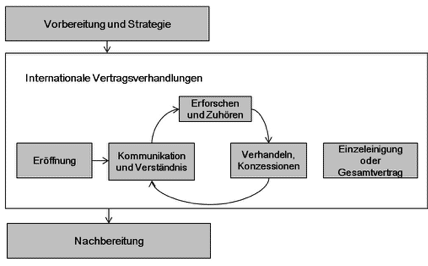
These ground rules include a clear four-step negotiation process: Opening the negotiations and setting key milestones (Part 1), communicating and exploring the other party’s interests (Part 2), the actual negotiation (Part 3), and reaching an agreement and, ideally, concluding a contract (Part 4). The outcome of a negotiation may initially be only a partial agreement, before further issues are negotiated in a subsequent round. Furthermore, the process of reaching an understanding, listening and negotiating may be repeated several times. Particularly in people-oriented cultures, such as those in the Middle East, Asia or Russia, negotiations can drag on for a considerable period of time.
In many countries, the personal level is perhaps even more important than the factual level. To avoid serious conflicts, it is therefore important to keep the two levels separate. Often, the other party is seen not as a representative of a company, but as a person. Consequently, frustration over an unpleasant situation can lead to taking that anger out on the other person. To avoid this, it is best to keep relational elements – such as understanding, respect, affection, fear and anger – strictly separate from factual elements – such as prices, specifications, competitive advantages, and payment and delivery terms. You can always negotiate your interests consistently, whilst at the same time treating your counterpart with courtesy.
The aim
Personal respect and integrity are essential components of any business relationship, whether national or international. In this context, it is impossible to provide a one-size-fits-all formula for successful negotiation at an international level. Furthermore, it is not the intention to teach rhetorical tricks that might be used to „deceive“ or „cheat“ the other party. The following focuses on conscious negotiation, i.e. how to act in a factual, rational and structured manner. It is in the negotiator’s primary interest
to negotiate effectively and professionally
to avoid ineffective conflicts
to achieve appropriate results as quickly as possible
To foster a sense of commitment, even in an intercultural context.
Once thorough preparation has been carried out, including clearly defining what you want to achieve, the actual negotiations can begin. Negotiations generally follow the pattern shown in the diagram below, although the process of reaching an understanding, listening and negotiating may be repeated several times. The final agreement is often reached through a series of partial agreements.
The diagram above clearly illustrates the overall structure and dynamics of contract negotiations. In principle, these are based on thorough preparation, the reaching of partial agreements and, subsequently, the continuation of negotiations. Ultimately, an overall contract is concluded (or not).
It is worth considering the following points regarding each step:
The preparation
Before the actual negotiations begin, you should try to get to know your counterpart. The more you know about them – both professionally and personally – the better. That is why it is very important to create a positive atmosphere at the start of a negotiation.
Politeness and hospitality go without saying in this context. Added to this are an interest in your counterpart as a person, open communication, friendly eye contact and, last but not least, a sense of humour. Furthermore, national customs play a very significant role in international negotiations.
As a general rule, it is advisable to allow sufficient time for negotiations. Time pressure often leads to a great many negative outcomes. A lack of time is often used as a means of exerting pressure, particularly in international negotiations.
Anyone who defines the specific topic for a negotiation in advance can expect the negotiation to proceed according to plan and not get out of hand. A useful approach is to structure the discussion into a main topic, sub-topics, and main and supporting arguments. This helps to structure a matter that may initially seem complex, making it clearer both in itself and to the other party. The following points should be borne in mind:
Agenda – organise the topic of the meeting
Definition of key terms, as it is often the case – ideally in consultation with the other party – that the precise definition of these terms is crucial
Developing a negotiation strategy and preparing to achieve one’s own objectives, whilst also considering the other side’s priorities
Flexibility – exploring options and reconsidering possible concessions
A step-by-step approach – moving from the smaller to the larger issues as the negotiations progress
The line of reasoning
In addition to personal considerations, the procedural approach is also important, and a clear structure for the discussion is essential. When it comes to presenting your case, care should be taken not to begin the negotiation in a manner that is too cold or too matter-of-fact. This style of negotiation, characterised by high opening positions and negative statements such as „this far and no further“, is regarded in many countries as far too demanding. There is also a risk of losing face if one relents on one’s expectations as the discussions progress.
It is therefore important not to adopt positions that are too extreme from the outset, but rather to establish reasonable ones. Factors such as saving face and taking an interest in the other party’s culture and personality are generally of great importance. You should therefore negotiate less on positions and more on the underlying interests. Anyone who manages to summarise the other party’s position effectively and then explain their own viewpoint will significantly improve their chances of success.
A clear and therefore consistent line of argument should be well prepared. Preparing for this usually takes some time. It is advisable to check that your own position – and any changes to it – is logically sound. At the same time, you should develop as many options as possible in advance for your negotiating objective and strategy.
It is equally important to take into account any objections the other party might raise, insofar as they are foreseeable, so as to be able to respond to them promptly and appropriately.
In reality, however, such preparation is often lacking, particularly due to time constraints. The parties usually go into negotiations ill-prepared and with a solution which they believe to be correct and therefore infallible; conflicts are then inevitable.
Please bear in mind that there are few other areas where so much can be gained – but also lost – so quickly as in international negotiations. In the next section, we will look at the correct structure and show how helpful a change of perspective can be in this context.
Recruitment agencies regularly receive new and interesting job vacancies from their corporate clients and then assess which candidates from their talent pool might be suitable. If a candidate’s qualifications match the requirements of the recruiting company, it’s a match. The more detailed a candidate’s profile is, the more effective the matching process will ultimately be.
It is essential that the data on file is up to date. If, for example, a candidate has stated that they are open to a change of job, but this information is out of date, it ultimately leads to disadvantages for both parties. On the one hand, the recruitment consultant contacts the candidate in the hope of placing them, but is unsuccessful. On the other hand, the candidate may receive what they perceive as unwanted calls or emails from the recruitment agency.
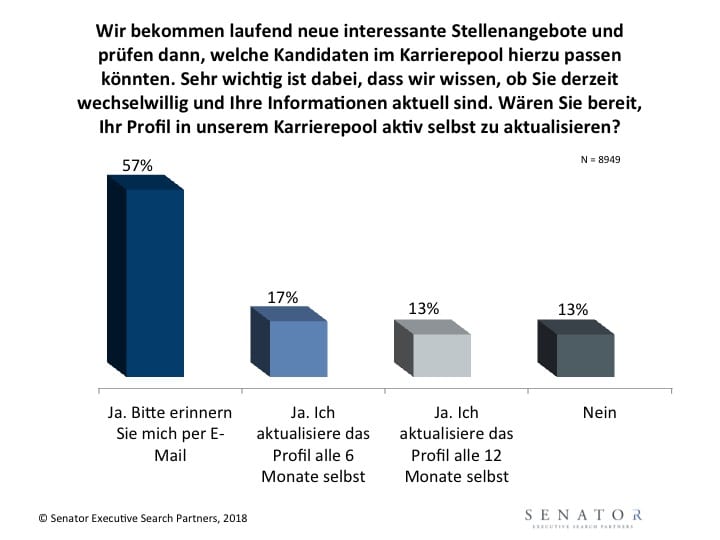
To ensure that candidate pools remain up to date, candidates’ cooperation is therefore essential. HR experts at HR Consult Group AG have investigated the extent to which candidates are willing to do this, amongst other things, in their study involving over 10,000 participants.
More than half would like to be reminded by email
Generally speaking, the majority of respondents (57 per cent) are willing to review their candidate profile regularly and update it where necessary. Just over half would like to receive a reminder by email, whilst 17 per cent would update their profile every six months. Thirteen per cent of candidates stated that they update their profile once a year. Conversely, 13 per cent are not prepared to update their details themselves.
We are delighted with this positive feedback from those surveyed. The up-to-date nature of the data in our candidate pool is one of the keys to our work. Only with up-to-date data can we guarantee perfectly matched placements and thus help both our clients and our candidates take the next step in their careers in the best possible way.
After completing his degree in Automotive Engineering and Industrial Engineering, he began his career in the automotive industry in the fields of sales, development and marketing, and also spent a year in Japan working for one of the largest automotive suppliers.
He then moved to a world-renowned premium car manufacturer, where he served as a marketing officer responsible for product marketing in Japan and South America, and as a marketing officer responsible for marketing strategy in North and South America.
In 1994, he decided to set up his own business and founded a recruitment consultancy in Munich, which he has been developing and expanding for over 20 years. As managing director, his main areas of focus are, naturally, the automotive sector and mechanical and plant engineering.
His PhD in the field of aptitude assessment perfectly complements his areas of expertise, particularly with regard to HR and management consultancy. His thesis focuses on identifying and demonstrating typical personality traits among engineers, as well as defining areas for development to ensure a successful career.
These are scientifically derived and presented in the book *Aptitude Testing in Practice*.
At the same time, his focus is on building networks and cooperation models, as well as the ongoing development of systems and processes in HR consultancy.
Over the past 20 years in the field of HR consultancy, he has developed several brands that continue to operate successfully in the market to this day.
„The world has changed – things will never go back to normal – and that’s exactly what you have to love!“
All companies are facing this changed world. Buzzwords such as digitalisation, increased flexibility, globalisation, competitive business management, communication on an equal footing, and shifts in values and culture – to name but a few – are making the rounds in every department.
In order to be able to cope with these issues in all their complexity, a new „mindset“ is needed amongst senior management and absolutely essential in the minds of HR departments.
The process of change in the labour market has been evident for years – demographic change is not something that has only just come to light. By 2020, there will be a shortfall of 6 million people – due to the low birth rates in the 1970s and 1980s. Closely linked to this is the ageing of society. This poses equally significant challenges for businesses. These facts should serve as a wake-up call to all companies, because it means that those who do not act now – those who do not change their „mindset“ now – will, within the next three to five years, lose a crucial competitive advantage: people, plus the ability to identify and develop them for a company.
The era of „Post & Pray“ is long gone – standard job adverts have not been generating the desired number of applications for quite some time now. It is therefore essential to explore new avenues – one option among many is to establish a strategic talent relationship management system. This can also be summarised effectively in a single sentence:
„Discovering tomorrow’s talent today.“
But how? This is precisely where „out-of-the-box” thinking comes in: finding talent – and by that we really do mean all potential candidates, whether active or passive – wherever they are. They’re certainly not hanging around on just any old online job board. Finding talent doesn’t mean spending the whole day online or at your desk. It means getting out and about, visiting trade fairs, actively building a network, being proactive in the market, making the most of events, and so on.
„Be brave and creative.“
Go where the talent is. For example, with the help of a „talent scout“. Where, for example, can you find young, innovative fashion designers? The best places are the various fashion fairs in Berlin, Amsterdam and so on. The talent scout’s sole task is to approach these talented individuals directly on the ground and establish contact – not to approach them for a specific role. Their role is to build a long-term, strategic relationship – to get the talent excited about the company today, so that when a suitable position becomes vacant, they can offer it to that talent. However, it also means that close contact with the talent should be established over time. A one-off birthday card is not enough – you need to stand out and stay in touch with the talent on a personalised basis. When implementing such measures, it should never be overlooked that, in order to build and maintain a strategic talent relationship pool, top management must provide the necessary support for the talent scout’s role. It is equally important that the underlying processes for a talent relationship management pool are supported as effectively as possible by a well-functioning tool, for example one embedded within an existing applicant tracking system.
Establishing a strategic talent relationship management system takes time – but saves money in the long run – as it leads to recruitment that is perfectly tailored to the organisation’s needs.
Now is the time to break new ground, put these ideas into practice and thereby gain a decisive competitive advantage.
Ms Petra Carl is a fully qualified lawyer specialising in employment law. She has been working in human resources for 20 years and has learnt ‚her trade‘ from the ground up; she has headed up HR departments in various companies and has consistently developed these departments in line with the challenges of the labour market in recent years. As a long-standing HR manager in the fashion and lifestyle sector, she possesses in-depth knowledge of HR processes. Her expertise covers the entire employee lifecycle.
The five key areas of its further development are employer branding, the candidate journey, social media-based active sourcing, direct outreach and strategic talent relationship management.
At Senator Executive Search Partners, Petra Carl is responsible for HR process optimisation. She offers the following services for your HR department:
tailor-made, forward-looking HR solutions
Support and guidance in transforming your current HR system into a ‚state-of-the-art‘ one‘
Development of ‚HR 4.0‘, with particular emphasis on its five key areas
There is likely to be broad agreement amongst experts and business leaders alike that compliance has now become a necessity. At the same time, it is clear that compliance is subject to constant change and that companies must continually adapt their compliance management systems to meet new requirements. It is therefore important for the future to know what compliance challenges lie ahead and what trends can be expected.
The year 2017 alone saw two key compliance issues:
On the one hand, there is money laundering, which has become a more pressing issue following the implementation of the 4th EU Anti-Money Laundering Directive. On the other hand, there is data protection, with the associated challenges, particularly for information security. The EU General Data Protection Regulation (GDPR) came into force in May 2018.
Apart from IT and data security, another key focus is the introduction and implementation of business partner due diligence. „It will be just as interesting to see to what extent the new ISO 37001 standard can provide impetus for corruption prevention as it will be to continue monitoring the development of the relationship between corporate responsibility, sustainability and compliance within organisations. Ultimately, the measurability of compliance measures will remain important.“. 28
Compliance in the future must focus more closely on the expectations of the company’s stakeholders. „Customers increasingly want to be able to rely on a clean supply chain. Consequently, the competitive relevance of compliance for companies is increasing,“ according to the authors of the study „The Future of Compliance 2017“. This is because, when asked which stakeholders have the greatest interest in a functioning CMS, customers were the most frequently cited, at 62 per cent.29
Against a backdrop of scarce resources – particularly in small and medium-sized enterprises – the question of a bespoke, tailor-made CMS is becoming increasingly important. The differences in the respective compliance functions are primarily determined by the sector to which the company belongs. Many companies continue to base their approach on IDW PS 980 (Audit Standard). This is certainly justified, as it is widely recognised and also fulfils the key requirements for an „effective compliance management system“, as demanded, for example, by case law. However, it must be borne in mind that the structure of the IDW auditing standard – particularly for companies operating in a so-called „regulated sector“ – must also incorporate the requirements of specific regulatory guidelines (e.g. BaFin guidelines or GMP requirements for pharmaceutical companies).
In our experience, there are still very differing views on what compliance means for a company. For instance, many decision-makers still hold the view that compliance is limited to meeting regulatory requirements. In our view, more intensive information and awareness-raising within companies is still needed to convey that compliance is much more than this and can make an important contribution to corporate culture. Against this backdrop, we regard the „promotion of a compliance culture” as one of the most prominent issues to be highlighted in the context of the future of compliance. Closely linked to this is the communicative aspect, as establishing a compliance culture within a company requires intensive and targeted communication.
The fact that many organisations also have other management systems in place – such as quality and/or environmental management systems – means that the integration of a CMS into existing management systems is considered a high priority. This is all the more so as it can create synergies and save costs.
28 Compliance Trends in 2017, in: Compliance – The Journal for Compliance Officers, February 2017 issue
29 The Future of Compliance 2017 – Challenges and Trends in Compliance Management, in: https://www2.deloitte.com/de/de/pa- ges/audit/articles/future-of-compliance
Studied law and business administration, followed by a postgraduate Master of Business Administration (MBA) programme. Undertook further professional development alongside work to qualify as a European Quality Manager (DGQ), a mediator specialising in commercial mediation, and a Certified Compliance Manager (TÜV).
Eckart Achauer spent around 10 years in the international insurance industry, holding various management positions within a Swiss insurance group (claims department, sales, assistance), before moving into management and business consultancy in 1997.
As a consultant and managing director of various consultancy firms, Mr Achauer has specialised in organisational and process optimisation, as well as in the development and implementation of management systems – quality management, risk management and compliance management.
At HR Consult Group, Mr Achauer is responsible for the Compliance Management division. As part of compliance audits, he analyses organisations„ “compliance fitness’, raises awareness and provides training for management, executives and staff, and supports companies in developing and implementing bespoke compliance management systems. In doing so, he always takes into account the specific risk profile of each company. Thanks to his many years’ experience as a manager and consultant, he is thoroughly familiar with the practical challenges faced by businesses.
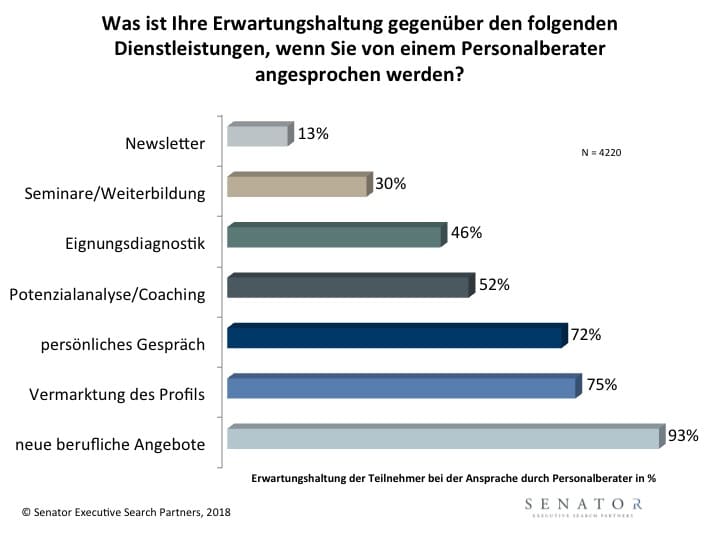
Anyone wishing to offer their candidates particularly high-quality services should have a thorough understanding of the target group’s needs and preferences and tailor their offering accordingly. To help with this, the recruitment experts at HR Consult Group AG conducted a candidate survey – to which more than 10,000 people responded – to investigate, amongst other things, which benefits candidates value most highly.
The top responses come as no surprise: at 93 per cent, almost all candidates expect to receive new job offers from recruitment consultants. Three-quarters of those surveyed expect their profile to be actively marketed by the recruitment agency and put forward to potential employers. A similar proportion of participants – 72 per cent – regard a face-to-face meeting with a consultant as an integral part of the process. The main focus here is on personalised service and building a relationship of trust.
More than half expect an aptitude assessment / a potential analysis
In fourth and fifth place in the ranking are coaching sessions and a potential analysis, accounting for a total of 52 per cent, and aptitude assessment procedures, accounting for 46 per cent. Both methods aim to identify the candidate’s strengths and weaknesses, thereby potentially uncovering entirely new professional focuses and career prospects.
„Candidates“ main expectations of a recruitment consultancy are quite clear. We are expected to help them find a job, and that is, of course, precisely our role. What is interesting, however, is that the survey respondents clearly attach great importance to a personal and individual dialogue. As recruitment consultants, we very much welcome this, as this direct and personal connection allows wishes and goals to be defined more quickly, effectively and clearly. Combined with the analytical tools at our disposal, this enables us to find the right role and the right employer for each candidate very efficiently and with great precision,” explains Mr Lars Osmers, recruitment consultant at SENATOR.