In recent years, the People’s Republic of China has grown to become a major economic player on the world stage. The financial crisis has done nothing to change this; quite the contrary. Furthermore, in light of recent political developments in the United States, China is becoming an increasingly important partner for Europe. China’s rapid growth has slowed during the political turbulence and uncertainties of the recent past – albeit still at an above-average rate of approximately 6 % to 7 % („the new normal“). The Chinese market remains attractive to German investors and business partners, particularly due to its considerable domestic market potential. Conversely, we are seeing a trend whereby Chinese companies are increasingly beginning to invest in Europe and, above all, in German-speaking countries.
It is not only global players such as Volkswagen, BASF, Bayer, Coca-Cola, Henkel and Procter & Gamble – to name but a few – that have a presence in the Middle Kingdom. German SMEs are now also heavily involved in a wide variety of ways. But is this vast country really a rapidly developing and promising future market that justifies sustained, long-term investment? China is not just China. The People’s Republic is a world unto itself, with a history stretching back over 4,000 years, various languages and dialects, and diverse social conditions and behavioural patterns. The country’s size, its gradual opening up to the West and its rapid economic growth make China a significant growth market that is highly attractive to foreign investors. According to Volkswagen, China is the fastest-growing market in the world. Yet not every business venture is crowned with success. Many companies have failed to achieve the quick returns they had hoped for. What mistakes do Western entrepreneurs make when doing business in China? What are the specific challenges involved in negotiating, doing business and running a company on the ground?
The Middleman
Western businesspeople have little chance of closing a deal in China without a middleman, also known as a „Zhong-jian Ren“. This middleman is familiar with the specific, personal and reciprocal system of relationships that prevails in China, which goes beyond what is traditionally understood as networking in the West. In the West, we often tend to trust others until we have reason not to do so.
In China, things are a little different: in business, you cannot build trust, as no business relationship of any kind can even come about without trust. Instead, trust must be established through „guanxi“. This Chinese
The term refers to the network of personal relationships in China; in other words, it is based on mutual give and take. This means, for example, that a business partner you trust will introduce you to business partners whom they, in turn, trust. The crucial first step in China during this phase of the negotiations – also known as the „exploratory phase“ – helps you to establish personal contacts with the relevant company or managing director.
A talented Chinese intermediary remains indispensable even after the first meeting. Consider what happens during a typical negotiation session between Chinese and Western businesspeople. Rather than saying ‘no’ outright, Chinese businesspeople prefer to change the subject, remain silent, ask a different question or respond using ambiguous or vaguely positive expressions that carry a slightly negative undertone.
A native Chinese speaker is able to accurately interpret the moods, facial expressions and body language displayed by Chinese negotiating partners during a formal meeting, and to explain them. Often, only the intermediary can determine what is actually happening. If an impatient negotiating partner from the Western world wants to know what the Chinese think of the proposal, they will invariably respond evasively, for example with „Let’s see“ or „Let’s look into it“ – even if they think there is something wrong with the proposal. This is one of the situations in which the intermediary can step in, as their role is less about translating words and more about mediating between cultures.
It is often the case that both parties can speak openly to the intermediary about matters they would be unable to discuss directly with one another. In China, it is the intermediary, not the actual negotiating partner, who first raises the business issue to be discussed. Furthermore, they are often able to bridge differences. In fact, a good intermediary can succeed in significantly reducing complex situations and substantial differences of opinion.
So far in 2018, there have been more than 44 million people in employment in Germany. The vast majority of them work either full-time or part-time. But what new ideas and regulations are there regarding working hours?
Full-time employment is defined as working between 36 and 40 hours per week. The standard arrangement is to work 8 hours a day, 5 days a week, provided no overtime is worked. This is because, with 1.7 billion hours of overtime in 2017, Germany is well ahead of the pack when it comes to overtime.
However, too much work can have both mental and physical consequences. This has long been common knowledge. More than half of all employees already complain of back and joint problems. Exhaustion comes in second place. Headaches take third place.
But what can be done about it? Is it possible to reduce working hours by 20 per cent whilst keeping salaries the same? One study has already shown that around 18 million people in this country would be happy to work fewer hours.
That is exactly what a New Zealand company tested for two months. They introduced a four-day working week. A team of researchers from the University of Auckland monitored the trial. The only condition for the employees was that they had to meet their weekly work targets.
The result of this test was clear. The employees were more productive and happier than before. Stress levels also fell significantly.
Admittedly, at first glance it does seem paradoxical. A four-day week can, after all, present a number of hidden problems. For example, staff costs rise because more staff are needed. Nevertheless, researchers believe that savings are possible.
Another way of reducing the working hours for a full-time role is to introduce a six-hour working day on full pay. After all, people can be just as productive in six hours as they are in eight. Studies have already shown that many people can only really concentrate on their work for a few hours a day.
Some companies have even tried out a six-hour working day. And with success. Their turnover increased.
However, here too, the higher staff costs represent a major drawback.
The second type of working arrangement is part-time work. In the next article Find out more.
After completing his degree in Automotive Engineering and Industrial Engineering, he began his career in the automotive industry in the fields of sales, development and marketing, and also spent a year in Japan working for one of the largest automotive suppliers.
He then moved to a world-renowned premium car manufacturer, where he served as a marketing officer responsible for product marketing in Japan and South America, and as a marketing officer responsible for marketing strategy in North and South America.
In 1994, he decided to set up his own business and founded a recruitment consultancy in Munich, which he has been developing and expanding for over 20 years. As managing director, his main areas of focus are, naturally, the automotive sector and mechanical and plant engineering.
His PhD in the field of aptitude assessment perfectly complements his areas of expertise, particularly with regard to HR and management consultancy. His thesis focuses on identifying and demonstrating typical personality traits among engineers, as well as defining areas for development to ensure a successful career.
These are scientifically derived and presented in the book *Aptitude Testing in Practice*.
At the same time, his focus is on building networks and cooperation models, as well as the ongoing development of systems and processes in HR consultancy.
Over the past 20 years in the field of HR consultancy, he has developed several brands that continue to operate successfully in the market to this day.
To reach the next stage in your career, certain requirements must be met. Do an employee’s skills exceed the scope of their current role? Or are they prepared to relocate if necessary?
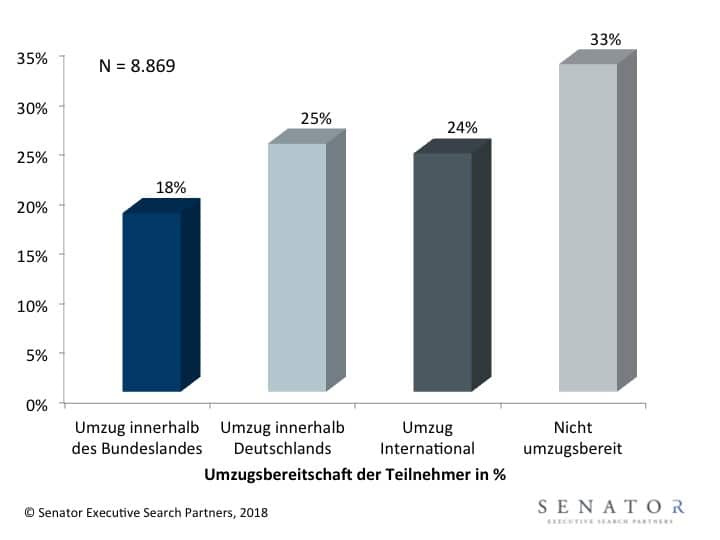
To answer this final question, the HR experts at HR Consult Group AG conducted a candidate survey involving more than 10,000 participants to find out how willing our candidates are to relocate.
The analysis reveals that, broadly speaking, two-thirds of all candidates are willing to relocate. As many as 24 per cent would even be prepared to move abroad. Exactly a quarter do not wish to leave Germany for the sake of their next career move. Only 18 per cent wish to remain in their current federal state.
This means that if you have a vacancy for which a candidate would have to change their place of residence, your pool of candidates is limited to 67 per cent of all candidates.
The remaining 33 per cent are not prepared to move house.
After completing his degree in Automotive Engineering and Industrial Engineering, he began his career in the automotive industry in the fields of sales, development and marketing, and also spent a year in Japan working for one of the largest automotive suppliers.
He then moved to a world-renowned premium car manufacturer, where he served as a marketing officer responsible for product marketing in Japan and South America, and as a marketing officer responsible for marketing strategy in North and South America.
In 1994, he decided to set up his own business and founded a recruitment consultancy in Munich, which he has been developing and expanding for over 20 years. As managing director, his main areas of focus are, naturally, the automotive sector and mechanical and plant engineering.
His PhD in the field of aptitude assessment perfectly complements his areas of expertise, particularly with regard to HR and management consultancy. His thesis focuses on identifying and demonstrating typical personality traits among engineers, as well as defining areas for development to ensure a successful career.
These are scientifically derived and presented in the book *Aptitude Testing in Practice*.
At the same time, his focus is on building networks and cooperation models, as well as the ongoing development of systems and processes in HR consultancy.
Over the past 20 years in the field of HR consultancy, he has developed several brands that continue to operate successfully in the market to this day.
Experience shows that many companies do not include their business partners in their compliance programme. This is a failure that carries significant risks.
Statutory provisions, such as the German Commercial Code or company law, stipulate that companies – as well as individual governing bodies and employees – may be held liable for the unlawful conduct of business or contractual partners.
A practical example illustrates the fundamental issue: a company uses external sales partners who are paid on a commission basis. Their earnings therefore depend on the turnover they generate. If a sales partner then engages in fraudulent acts to successfully secure deals – such as bribing a potential client – the business partner’s conduct reflects badly on the company, even if the company itself has not acted unlawfully. The company faces financial and criminal consequences, as well as a significant loss of reputation.
Business partners are often not involved
Many companies are ill-prepared for this risk. The study „Compliance Management – the business challenge“ by AGAMON Consulting GmbH (www.agamon-consulting.de) highlights the shortcomings of small and medium-sized enterprises in this regard. For the majority of the companies surveyed, their compliance programmes are directed 100% towards both managers and staff. Suppliers and subcontractors are included in around 75 per cent of cases, whilst business partners are only taken into account in around 25 per cent of cases. It is well known, however, that external parties are at least involved in around half of all economic offences.
An often underestimated risk
„The risks that may arise from business partners such as intermediaries, negotiators and consultants should not be underestimated. Their breaches of compliance can lead to fines and claims for damages. Further consequences can range from exclusion from public contracts to criminal prosecution. Companies jeopardise their image and reputation if they do not select their partners carefully.”.
Every company’s compliance programme should therefore, as part of a holistic approach, definitely include business partner compliance management.
Eckart Achauer
Studied law and business administration, followed by a postgraduate Master of Business Administration (MBA) programme. Undertook further professional development alongside work to qualify as a European Quality Manager (DGQ), a mediator specialising in commercial mediation, and a Certified Compliance Manager (TÜV).
Eckart Achauer spent around 10 years in the international insurance industry, holding various management positions within a Swiss insurance group (claims department, sales, assistance), before moving into management and business consultancy in 1997.
As a consultant and managing director of various consultancy firms, Mr Achauer has specialised in organisational and process optimisation, as well as in the development and implementation of management systems – quality management, risk management and compliance management.
At HR Consult Group, Mr Achauer is responsible for the Compliance Management division. As part of compliance audits, he analyses organisations„ “compliance fitness’, raises awareness and provides training for management, executives and staff, and supports companies in developing and implementing bespoke compliance management systems. In doing so, he always takes into account the specific risk profile of each company. Thanks to his many years’ experience as a manager and consultant, he is thoroughly familiar with the practical challenges faced by businesses.
Eckart Achauer studied law and business administration, followed by postgraduate studies leading to a Master of Business Administration (MBA). He undertook further professional development alongside his work to qualify as a European Quality Manager (DGQ), a mediator specialising in commercial mediation, and a Certified Compliance Manager (TÜV).
He spent around 10 years in the international insurance industry, holding various management positions within a Swiss insurance group (claims department, sales, assistance), before moving into management and business consultancy in 1997.
As a consultant and managing director of various consultancy firms, Mr Achauer has specialised in organisational and process optimisation, as well as in the development and implementation of management systems – quality management, risk management and compliance management.
At Senator Executive Search Partners, Mr Achauer is responsible for the Compliance Management division. As part of compliance audits, he analyses organisations„ “compliance fitness’, raises awareness and provides training for management, executives and staff, and supports companies in developing and implementing bespoke compliance management systems. In doing so, he always takes into account the specific risk profile of each company. Thanks to his many years’ experience as a manager and consultant, he is thoroughly familiar with the practical challenges faced by businesses.
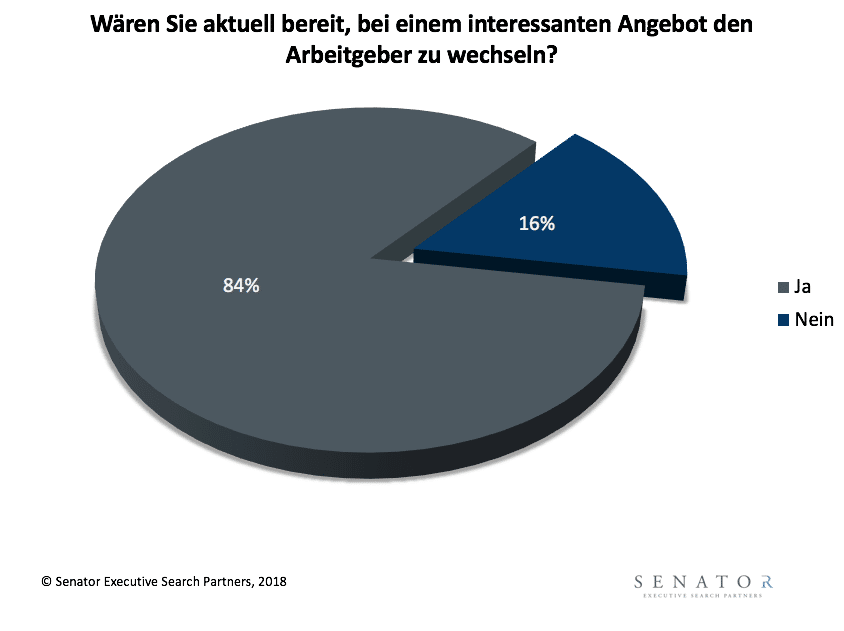
Would you currently be willing to change employers if an interesting opportunity arose? This is one of the key questions that recruitment agencies ask potential candidates, as a willingness to change jobs is a core factor in their day-to-day business. It is therefore hardly surprising that the HR experts at HR Consult Group AG asked precisely this question, amongst others, in a recent survey. The aim of the study, which involved over 500,000 respondents, is to tailor the services offered by recruitment consultancies as precisely as possible to the wishes and needs of candidates.
The result: at 84 per cent, the vast majority of survey respondents say they are open to changing jobs.
New challenges as a motivation for a change
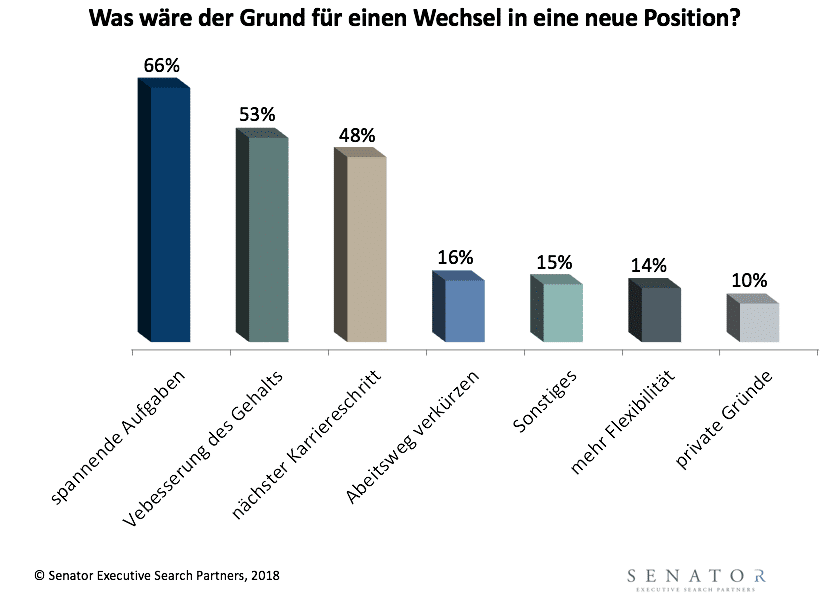
There are many reasons why employees are willing to change jobs. The most common reason cited (66 per cent) is a desire for a new, exciting role. A pay rise comes second (53 per cent). Just under half of those surveyed (48 per cent) say they want to take the next step up the career ladder. If this is not possible within their current company – for whatever reason – the only option is to move on.
These are followed, some way behind, by a shorter commute, the need for greater flexibility and other (personal) reasons.
Changing employers is always a big step that requires careful consideration. Nevertheless, times have changed. It has not been the norm for some time now to spend several decades – or even one’s entire working life – with the same employer. Changing jobs and employers also always offers the potential for personal development. With every change, the candidate learns something new, whether it be the differences in company size and structure or the scope of national and international operations.
After completing his degree in Automotive Engineering and Industrial Engineering, he began his career in the automotive industry in the fields of sales, development and marketing, and also spent a year in Japan working for one of the largest automotive suppliers.
He then moved to a world-renowned premium car manufacturer, where he served as a marketing officer responsible for product marketing in Japan and South America, and as a marketing officer responsible for marketing strategy in North and South America.
In 1994, he decided to set up his own business and founded a recruitment consultancy in Munich, which he has been developing and expanding for over 20 years. As managing director, his main areas of focus are, naturally, the automotive sector and mechanical and plant engineering.
His PhD in the field of aptitude assessment perfectly complements his areas of expertise, particularly with regard to HR and management consultancy. His thesis focuses on identifying and demonstrating typical personality traits among engineers, as well as defining areas for development to ensure a successful career.
These are scientifically derived and presented in the book *Aptitude Testing in Practice*.
At the same time, his focus is on building networks and cooperation models, as well as the ongoing development of systems and processes in HR consultancy.
Over the past 20 years in the field of HR consultancy, he has developed several brands that continue to operate successfully in the market to this day.
In the final instalment of our three-part series, we’ll be looking today at the correct structure and the benefits of a change of perspective.
The trial itself
Negotiations often begin with one party submitting its negotiating position to the other in writing, or having already sent it beforehand. This document may be a pre-drafted contract or may set out the key points of the deal (known in English as „Key Terms“ or „Basic Terms“). In the case of a company acquisition, for example, such key points would include the purchase price and the warranty provisions. In the case of a licence agreement, they would include the type of licences, the scope of the know-how, the amount of the licence fees and the duration of the agreement.
1. The exploration:
Find out what the other side is thinking
Find out what the other side is interested in
Try to see things from the other person’s point of view as often as possible
2. Communication:
Ask questions
Listen actively
Summarise your negotiating partners’ explanations briefly in your own words
Use examples and employ meta-level communication (which focuses not on what we talk about, but on how we talk to one another)
3. The other person:
Bear in mind any personal circumstances
Pay attention to how the person(s) is/are integrated into the company
4. Individuality:
Make sure you act fairly
Use humour (appropriately and in moderation)
5. The line of reasoning:
Compare like with like
The argument of reciprocity – putting oneself in the other person’s shoes and vice versa („tit for tat!“)
Outline
As part of the preparations for the negotiations, the importance of structuring the subject matter of the negotiations correctly has already been highlighted. Now, at the stage of the actual negotiations, this offers a further advantage: As a rule, the parties disagree on the content but not on the structure, because issues of substance do not yet seem to arise in the latter. For this reason, the other side is far more likely to agree to an outline proposed at the outset than to be persuaded by arguments relating to the content.
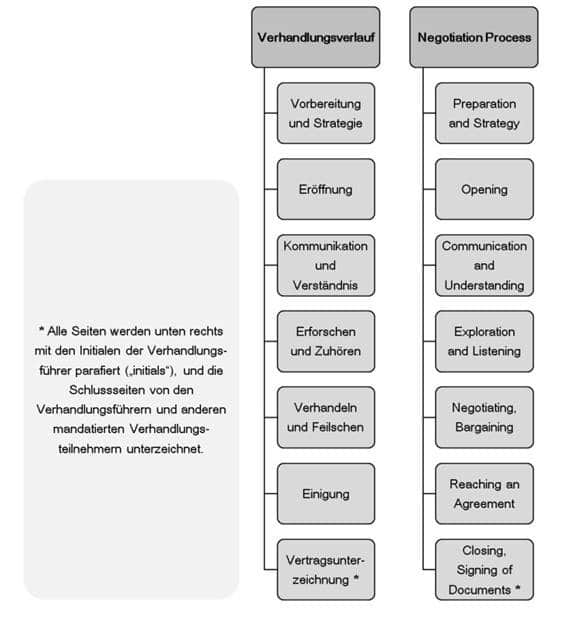
In this context, it is very helpful to take a step back and talk about themes rather than content and specific details. This allows the theme to take precedence over the content, and gives you control over when you raise certain topics. It is helpful to structure the negotiation into individual sections, as shown in the diagram below.
„Perspective-taking“
There is a way to distinguish between the two levels more easily: put yourself in the other person’s shoes and look at the negotiation from their perspective.
A „perspective approach“ makes it easier to recognise,
how the other side reacts to one’s own proposals,
whether their arguments are sound, and
whether what she says and what she really means are consistent or contradictory.
If you uncover contradictions based solely on the other party’s case, they will find it very difficult to refute them. You beat them at their own game – that is, using their own arguments – and in doing so, you also gain greater legitimacy.
In order to properly understand the other side’s point of view, one should let them finish speaking and listen attentively. After all, listening and understanding do not necessarily mean agreeing with a particular opinion. Rather, it gives you the opportunity to turn personal attacks into a factual discussion.
Listening attentively and allowing the other side to speak their piece helps them to vent their aggression during conflicts. And this aggression subsides extremely quickly when met with interested silence. The other party expects opposition, which they can then turn into „ammunition“ for themselves. If this is lacking, even the fiercest attack fizzles out very quickly. This prevents conflicts from escalating and helps to channel and control emotions.
Please bear in mind that there are few other areas where so much can be gained – but also lost – so quickly as in international negotiations. In the next issue, we will use a case study on the granting of a licence to illustrate further relevant aspects of international negotiations.
This three-part series has set out valuable tips for successful international negotiations and highlighted the specific factors that matter. Please always bear in mind that there are few other areas where so much can be gained – or lost – so quickly as here.