

Following the PREVIOUS PART Whilst the previous instalment in this series dealt with and introduced aptitude testing for engineers in general, this one focuses specifically on engineering-specific traits – in other words, the question of whether there are traits that typically characterise an engineer. Naturally, this also raises the question of whether such traits exist and, if so, which ones are responsible for career success.
In this analysis, it is necessary to identify both the personality traits that remain stable throughout an engineer’s career and those that change significantly in relation to age and position within the hierarchy. Only then can reliable conclusions be drawn about so-called ‘typical engineering traits’ and about the development of traits that are responsible for a successful career and progression up the career ladder.
The basis for this was the approach of looking for personality traits that remain consistent across all levels of the hierarchy. These would be traits in which an engineer rates themselves just as highly, whether they are just starting out in their career or acting as a manager.
If the hierarchy is used as a basis for comparing different characteristics, it becomes clear that personality traits such as, for example, Reliability and Cooperation assets, which remain virtually unchanged throughout one’s career. But topics such as Perfectionism and Planning for incidents are personality traits towards which the engineer maintains the same attitude throughout his or her entire career.
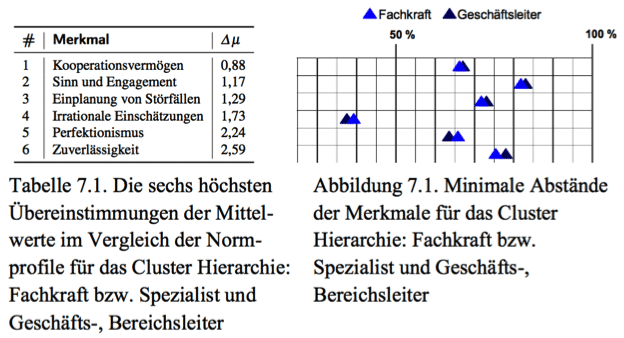
The characteristics set out in Table 7.1 and Figure 7.1 illustrate the progression from the lowest to the highest hierarchical level, which show the least change. These characteristics are therefore the least affected by progression up the career ladder. It can therefore be concluded that the characteristics shown are those that are characteristic of an engineer – from the perspective of progression up the career ladder, i.e. the development over time during their professional career – as they remain virtually unchanged.
With regard to personality traits
- Cooperative assets,
- Purpose and commitment,
- Planning for incidents,
- Irrational assessments,
- Perfectionism and
- Reliability
If the engineers’ attitude does not change, it stands to reason that, as far as these personality traits are concerned, the saying applies: An engineer is always an engineer.
In the search for personality traits that are responsible for professional development and progression up the career ladder, the focus has now turned to identifying the traits that undergo the greatest changes over the course of an engineering career. To this end, the results for engineers working as specialists, project managers, department heads and business unit managers were compared. It was found that the personality traits in question had undergone continuous development across all hierarchical levels, meaning that, for the purposes of this analysis, it is sufficient to consider only the lowest and highest hierarchical levels.
The table and diagram below show the personality traits that have changed the most from the lowest to the highest level in the hierarchy. Examples of these include Management responsibilities or Willingness to take responsibility.
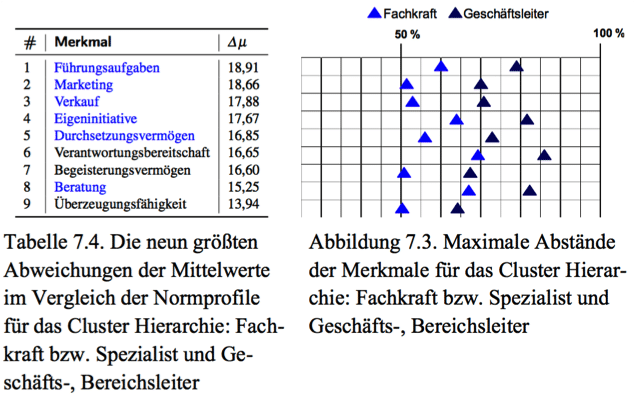
These characteristics (Table 7.4 and Figure 7.3) show the greatest changes as they progress from the lowest to the highest hierarchical level.
For example, the significant shift in interest in Management responsibilities It therefore seems to be of paramount importance for successful progression up the career ladder.
It can therefore be concluded that the characteristics highlighted are those which, from the perspective of climbing the career ladder – that is, the progression over time throughout one’s professional career – offer the greatest potential for development for an engineer, as they are the ones that change the most.
A comparison of the areas of development / potential that emerge from the perspective of development over time (the „Hierarchy“ cluster) and the other, time-independent clusters – that is, the static differences between the individual norm profiles – reveals the following:
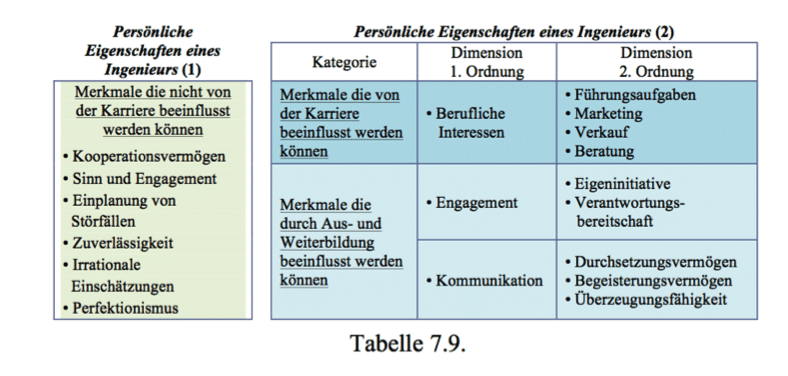
Table 7.9 shows a breakdown into first-order dimensions „Career interests“ and the first-order dimensions „Commitment“ and „“Communication' create. The former, as its name suggests, symbolises interests. As is well known, interests are not something that can be directly influenced, but rather something that takes shape and develops intrinsically.
Over the course of their career, engineers therefore develop interests that are sparked by their progression up the career ladder and continue to evolve, leading to a clear distinction in characteristics when comparing the standard profiles of „specialist“ and „manager“.
The situation is different when it comes to the characteristics of the other two first-order dimensions „Commitment“ and „Communication“: These are areas that can be improved through training and further education. As such, they can help you progress further in your career.
As part of staff development, therefore, personality traits and areas of interest should
- Management responsibilities,
- Marketing,
- Consultancy,
- Sales,
- Initiative,
- Willingness to take responsibility,
- The ability to inspire and
- Ability to persuade
be given special emphasis, addressed and further developed.
In summary, it can be said that a successful career depends not only on stable personality traits, but also on those traits that develop over the course of one’s career. Only when both are taken into account can the chances of a successful career as an engineer be maximised.
The next article on aptitude testing will look at standardised and best-practice profiles. These are required to interpret the results of any aptitude test. Do you know how standardised profiles and best-practice profiles are compared?
Image source:
Betz, Armin: Aptitude Testing in Practice – „An Engineer Remains an Engineer“, German National Library, 2015, pp. 165, 169, 174, ISBN 978-3-00-052093-8
About the author

After completing his degree in Automotive Engineering and Industrial Engineering, he began his career in the automotive industry in the fields of sales, development and marketing, and also spent a year in Japan working for one of the largest automotive suppliers.
He then moved to a world-renowned premium car manufacturer, where he served as a marketing officer responsible for product marketing in Japan and South America, and as a marketing officer responsible for marketing strategy in North and South America.
In 1994, he decided to set up his own business and founded a recruitment consultancy in Munich, which he has been developing and expanding for over 20 years. As managing director, his main areas of focus are, naturally, the automotive sector and mechanical and plant engineering.
His PhD in the field of aptitude assessment perfectly complements his areas of expertise, particularly with regard to HR and management consultancy. His thesis focuses on identifying and demonstrating typical personality traits among engineers, as well as defining areas for development to ensure a successful career.
These are scientifically derived and presented in the book *Aptitude Testing in Practice*.
At the same time, his focus is on building networks and cooperation models, as well as the ongoing development of systems and processes in HR consultancy.
Over the past 20 years in the field of HR consultancy, he has developed several brands that continue to operate successfully in the market to this day.