


As part of our "mini-series" on international negotiation, inourlastarticlewe discussedtheobjectives of negotiation as well as effective preparation and argumentation. Today, we will look at other key aspects of international negotiation using a case study.
Today, Peter H. is negotiating with representatives of the Australian company Smith Ltd., a competitor in the V-belt sector. Smith Ltd. wants to improve its product quality and is negotiating with Peter H. about a know-how license. Since it is not worthwhile for Peter H.'s company to produce in Australia itself for various reasons, he is also interested in granting a manufacturing license.
Smith Ltd. is seeking an exclusive manufacturing license for Australia. They have to invest heavily in implementing the know-how and therefore want to be protected in Australia. Peter H. is interested in a secure income from license fees. He fears losing money because if Smith Ltd. is unable to implement the know-how as planned, his license income, which is linked to Smith Ltd.'s sales, will remain low. Peter H. intends to grant a non-exclusive license so that he can sell a license to another company if necessary.
Failure seems inevitable. Both parties insist on their positions and the negotiating atmosphere deteriorates. The problem boils down to whether the manufacturing license should be exclusive or non-exclusive. Even if the parties agree on the other issues, the license becomes the core issue. A position-oriented negotiation approach not only leads to disagreement on the matter, but also to a mixing of the factual and relationship levels.
How can this problem be solved? Peter H. must try to negotiate objectively and in a way that focuses on interests. First, the unresolved issue of the "license" should be declared a common problem for both parties. Furthermore, a structure should be developed that shows where interests and common ground lie. Ideally, this structure should have been developed in advance by one of the parties and could look like the following illustration:
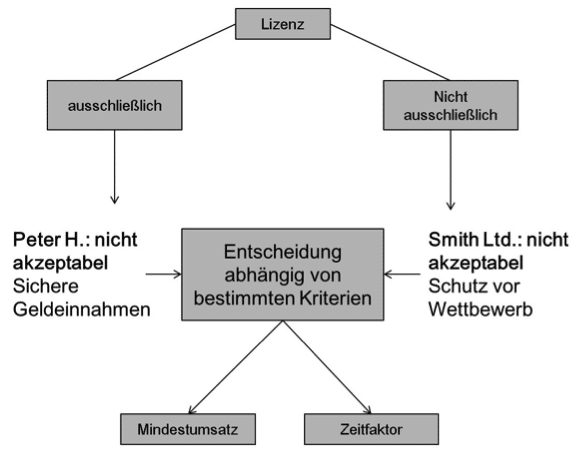
A closer analysis of these structures reveals that the interests of both parties overlap at a certain point: Peter H. grants Smith Ltd. an exclusive license on the condition that a certain minimum annual turnover is achieved after a specified start-up period. This ensures a minimum license fee. As long as Smith Ltd. achieves this minimum turnover, which may be staggered over the years, the license may not be granted to third parties in Australia. The exclusivity is therefore linked to a minimum turnover – the license is thus virtually exclusive and Smith Ltd. remains unrivalled in its country.
As a rule, both parties make concessions to each other during the course of the discussions and move closer to each other's positions. It is also important to negotiate each individual concession. A smart negotiating partner will only make a concession if the other party is prepared to make a concession in return. The better you know your own interests and those of the other side, the greater the opportunities for making concessions.
Relevant aspects of international negotiations:
Communication level
Analyze the other side's understanding of language, i.e., how in-depth and detailed their language skills are and how much overlap there is between what you say and what the other side responds with. The more accurate your analysis, the better you can assess whether the statements of both parties are congruent.
Active listening and questioning
Interests must be explored through attentive listening and questioning. The ability to listen is a trump card in the age of internationalization! Those who let their negotiating partners finish speaking, put themselves in their shoes, ask specific questions, and refrain from lecturing have a good chance of obtaining as comprehensive a picture as possible of the other side. Listening and understanding does not necessarily mean agreeing with a specific opinion. It also gives you the opportunity to uncover contradictions based solely on the other party's presentation. Then you can beat them at their own game, i.e., with their own arguments.
Definition of key terms
In many negotiations, it is a good idea to define key business terms together in advance. This reduces misunderstandings from the outset and structures the course of the negotiation.
Interests instead of positions
Positions are often associated with negative commitments and reflect personal attitudes. It is difficult to break away from such a standpoint without at least partially losing face. It is better to explore the interests hidden behind the obvious positions and discuss them.
Interest-based negotiation has a de-escalating effect and shows how to recognize the underlying ideas of both parties and find possible points of intersection.
Once you know the interests, it is easier to respond appropriately and effectively. Those who succeed in summarizing the position of the other party and then explaining their own point of view significantly improve their chances of success.
Expanding the scope of negotiations
Once you have explored both your own interests and those of the other party, new, previously unrecognized possibilities for a solution emerge—the scope of negotiations is thus expanded.
Contract coordinator
It often helps to appoint a contract coordinator on both sides. If this approach has not been common practice for your business partner in the past, you should explain the advantages of a functional working relationship. Taking all intercultural factors into account, emphasize your partner's obligation to cooperate in order to ensure that the necessary preparatory work for the contract negotiations is carried out. Propose the next steps and work out the individual implementation steps or milestones together with your partner: Who? When? With whom? How? Also determine who is responsible for meeting the milestones. This will ensure that the euphoria after a jointly achieved negotiation result does not fizzle out, but that the next steps proceed efficiently, quickly, and purposefully with the help of a contract coordinator.
To the last articleRules for conducting international negotiations (Part 1)
To the last article Rules for conducting international negotiations (Part 3)