

The first part of this series looked at the early pioneers of aptitude testing. We will now follow the story as it unfolds up to the present day.
Following the development of the MMPI (Minnesota Multiphasic Personality Inventory) and the CPI (California Psychological Inventory), the use of personality tests rose steadily until the early 1960s, when it peaked and then gradually declined. More than 80 per cent of all large companies used personality tests to select sales staff. By 1984, this figure had fallen to just over a quarter of companies. The reasons for this were the interactionist theory advocated by Walter Mischel (the interaction of personal and situational characteristics) and growing public opposition to the tests. This led to an intense political debate about these methods, in which aspects of test fairness were a particular focus.
It was not until 1980, starting in the United States, that the subject was revived and began to gain increasing prominence. Both academic and practical interest was rekindled. A shift can be observed, from tests that were initially merely translated to methods developed in-house, confirming a continued rise in interest right up to the present day.
It is interesting to note that the frequency of the terms „personality test“ and „aptitude assessment“ in German-language literature between 1900 and 2008, as drawn from the „Deutsch“ corpus, reveals some differences, even though the two terms have similar meanings. This is illustrated by the following figure from the book *Aptitude Testing in Practice – An Engineer Remains an Engineer*:
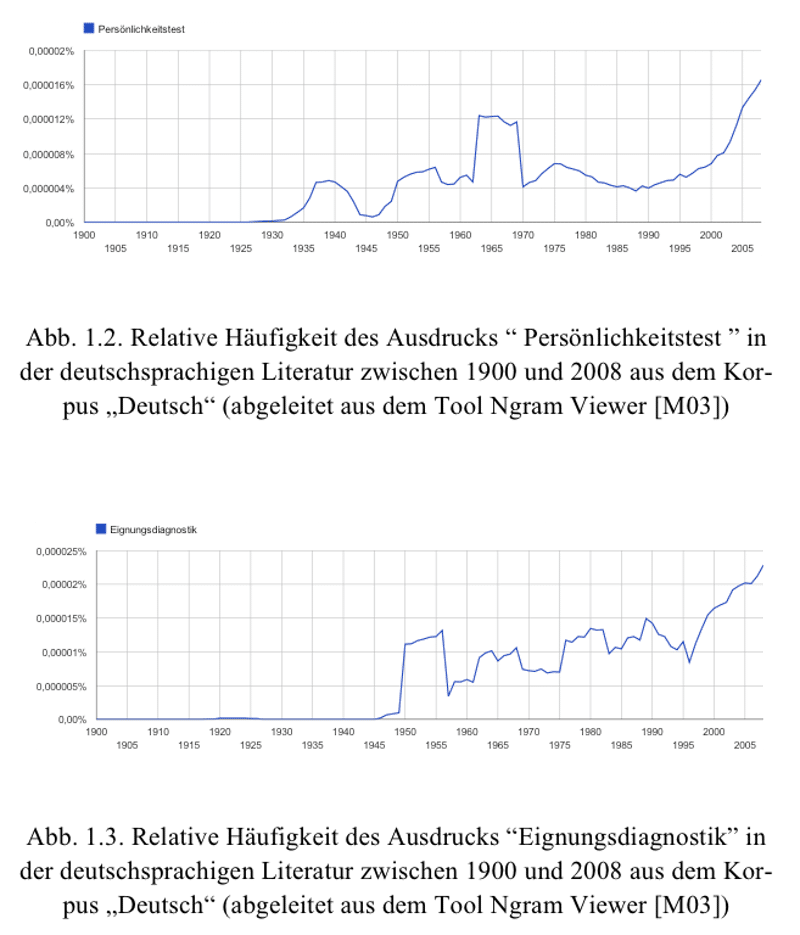
Whilst the term „personality test“ gained recognition relatively early on, as early as 1930, the term „aptitude testing“ only became truly popular after the Second World War, in 1945. Since 1957, following a sharp decline, „aptitude testing“ has seen a steady increase, albeit with several minor fluctuations. In contrast, the „personality test“ has repeatedly experienced significant dips in its usage. There is, however, one thing they have in common. Both terms have shown a marked increase since 1996, a trend that is set to continue steadily. This means that both terms have firmly established themselves in the 21st century and are continuing to grow in popularity.
Nowadays, aptitude assessment is a collective term for work-related procedures designed to measure skills and behavioural tendencies. In principle, aptitude assessment is intended to provide as accurate a prediction as possible of a person’s likelihood of success or their suitability for a particular role.
It should be noted that aptitude testing has an impressive history, and its development is set to continue.
Outlook: Our next article on this topic will focus on the book *Aptitude Testing in Practice – An Engineer Remains an Engineer* by Armin Betz. Do you know what key and typical characteristics define an engineer? You can find out about these and many other aspects, such as the importance of areas of development, in the following article.
About the author

After completing his degree in Automotive Engineering and Industrial Engineering, he began his career in the automotive industry in the fields of sales, development and marketing, and also spent a year in Japan working for one of the largest automotive suppliers.
He then moved to a world-renowned premium car manufacturer, where he served as a marketing officer responsible for product marketing in Japan and South America, and as a marketing officer responsible for marketing strategy in North and South America.
In 1994, he decided to set up his own business and founded a recruitment consultancy in Munich, which he has been developing and expanding for over 20 years. As managing director, his main areas of focus are, naturally, the automotive sector and mechanical and plant engineering.
His PhD in the field of aptitude assessment perfectly complements his areas of expertise, particularly with regard to HR and management consultancy. His thesis focuses on identifying and demonstrating typical personality traits among engineers, as well as defining areas for development to ensure a successful career.
These are scientifically derived and presented in the book *Aptitude Testing in Practice*.
At the same time, his focus is on building networks and cooperation models, as well as the ongoing development of systems and processes in HR consultancy.
Over the past 20 years in the field of HR consultancy, he has developed several brands that continue to operate successfully in the market to this day.