


In the final instalment of our three-part series, we’ll be looking today at the correct structure and the benefits of a change of perspective.
The trial itself
Negotiations often begin with one party submitting its negotiating position to the other in writing, or having already sent it beforehand. This document may be a pre-drafted contract or may set out the key points of the deal (known in English as „Key Terms“ or „Basic Terms“). In the case of a company acquisition, for example, such key points would include the purchase price and the warranty provisions. In the case of a licence agreement, they would include the type of licences, the scope of the know-how, the amount of the licence fees and the duration of the agreement.
1. The exploration:
- Find out what the other side is thinking
- Find out what the other side is interested in
- Try to see things from the other person’s point of view as often as possible
2. Communication:
- Ask questions
- Listen actively
- Summarise your negotiating partners’ explanations briefly in your own words
- Use examples and employ meta-level communication (which focuses not on what we talk about, but on how we talk to one another)
3. The other person:
- Bear in mind any personal circumstances
- Pay attention to how the person(s) is/are integrated into the company
4. Individuality:
- Make sure you act fairly
- Use humour (appropriately and in moderation)
5. The line of reasoning:
- Compare like with like
- The argument of reciprocity – putting oneself in the other person’s shoes and vice versa („tit for tat!“)
Outline
As part of the preparations for the negotiations, the importance of structuring the subject matter of the negotiations correctly has already been highlighted. Now, at the stage of the actual negotiations, this offers a further advantage:
As a rule, the parties disagree on the content but not on the structure, because issues of substance do not yet seem to arise in the latter. For this reason, the other side is far more likely to agree to an outline proposed at the outset than to be persuaded by arguments relating to the content.
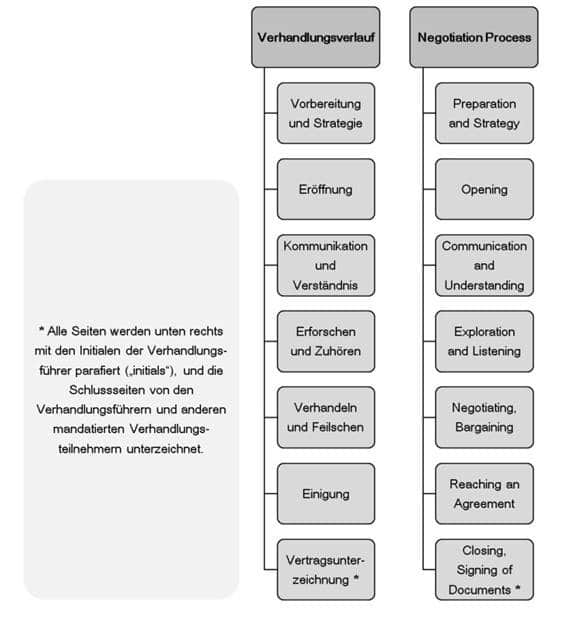
In this context, it is very helpful to take a step back and talk about themes rather than content and specific details. This allows the theme to take precedence over the content, and gives you control over when you raise certain topics. It is helpful to structure the negotiation into individual sections, as shown in the diagram below.
„Perspective-taking“
There is a way to distinguish between the two levels more easily: put yourself in the other person’s shoes and look at the negotiation from their perspective.
A „perspective approach“ makes it easier to recognise,
- how the other side reacts to one’s own proposals,
- whether their arguments are sound, and
- whether what she says and what she really means are consistent or contradictory.
If you uncover contradictions based solely on the other party’s case, they will find it very difficult to refute them. You beat them at their own game – that is, using their own arguments – and in doing so, you also gain greater legitimacy.
In order to properly understand the other side’s point of view, one should let them finish speaking and listen attentively. After all, listening and understanding do not necessarily mean agreeing with a particular opinion. Rather, it gives you the opportunity to turn personal attacks into a factual discussion.
Listening attentively and allowing the other side to speak their piece helps them to vent their aggression during conflicts. And this aggression subsides extremely quickly when met with interested silence. The other party expects opposition, which they can then turn into „ammunition“ for themselves. If this is lacking, even the fiercest attack fizzles out very quickly. This prevents conflicts from escalating and helps to channel and control emotions.
Please bear in mind that there are few other areas where so much can be gained – but also lost – so quickly as in international negotiations. In the next issue, we will use a case study on the granting of a licence to illustrate further relevant aspects of international negotiations.
This three-part series has set out valuable tips for successful international negotiations and highlighted the specific factors that matter. Please always bear in mind that there are few other areas where so much can be gained – or lost – so quickly as here.
To the last article Rules for Conducting International Negotiations (Part 1)
To the last article Rules for Conducting International Negotiations (Part 2)