

As part of aptitude testing, many personality traits are assessed. The so-called key criteria are particularly important in this context.
The question often arises as to which criteria a candidate must absolutely meet in order to successfully fulfil the requirements of a role. Or which personality traits are decisive in determining whether a job holder will succeed or fail. The key criteria identified through aptitude testing provide the answers to these questions.
Unlike the criteria defined by line managers or HR professionals as key criteria for specific roles, the key criteria used in the aptitude assessment at HR Consult Group AG are derived from the most significant characteristics of the relevant reference group.
The 10 key criteria of a standard or best-practice profile are derived from the group’s own findings. These are the criteria that show the least variation. This is where the degree of agreement is highest.
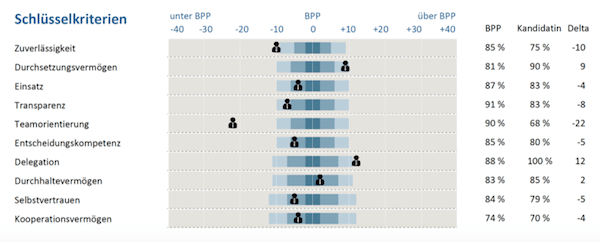
The analyses of the test results for the various characteristics each show different degrees of variation (see the sample analysis above); in other words, the range of test results varies from one characteristic to another. This is because the test subjects in a comparison group assess the individual characteristics differently.
The key factor here is that the range or variation of this characteristic is very narrow; in other words, the test subject forms an almost identical assessment of this topic and thus agrees with the comparison group that this characteristic, in precisely this form, is significant for this occupational group. Consequently, personality traits exhibiting the lowest variation or range become the key criterion for the respective position- or occupation-specific standard or best-practice group.
Key criteria therefore have the highest significance. These are assessed on the basis of the standard deviations. If the standard deviation is low, the variation caused by the results of the various tests is also low. This means that the values are closer to the mean. The result is a narrower range and, consequently, a clearer and more significant characteristic, which is referred to as a key criterion.
If a candidate’s score falls within the colour-coded range, as shown in the example above, the candidate falls within the benchmark profile. If the score is lower – that is, to the left of the benchmark group’s range – the candidate’s self-assessment of this characteristic differs significantly from that of their benchmark group. In this case, specific questions should be asked to find out why the candidate assesses themselves in this way. This usually indicates a characteristic with potential for development.
If their result falls to the right of the colour-coded range, they rate themselves higher than the comparison group on this point, which generally does indeed reflect a strength. The percentages shown on the far right indicate the exact average for the reference group, the candidate’s score and the resulting delta – that is, the exact deviation from the reference group’s average.
The key criteria can be sorted by degree of significance. Subsequently, depending on the approach chosen, a number of criteria are selected and assessed as key criteria. Various methods are conceivable and can be implemented effectively:
On the one hand, a fixed number of criteria can be selected, e.g. the first five or ten criteria. On the other hand, a percentage can also be specified, so that, for example, 20 % of all criteria are regarded as key criteria, which exhibit the lowest degree of variation.
The key insight is that the key criteria for successfully fulfilling a role emerge naturally and do not need to be identified through laborious consultation processes with specialist departments and the HR department.
The next instalment in our series will look at the soft skills that are virtually identical across a successful professional group.
About the author

After completing his degree in Automotive Engineering and Industrial Engineering, he began his career in the automotive industry in the fields of sales, development and marketing, and also spent a year in Japan working for one of the largest automotive suppliers.
He then moved to a world-renowned premium car manufacturer, where he served as a marketing officer responsible for product marketing in Japan and South America, and as a marketing officer responsible for marketing strategy in North and South America.
In 1994, he decided to set up his own business and founded a recruitment consultancy in Munich, which he has been developing and expanding for over 20 years. As managing director, his main areas of focus are, naturally, the automotive sector and mechanical and plant engineering.
His PhD in the field of aptitude assessment perfectly complements his areas of expertise, particularly with regard to HR and management consultancy. His thesis focuses on identifying and demonstrating typical personality traits among engineers, as well as defining areas for development to ensure a successful career.
These are scientifically derived and presented in the book *Aptitude Testing in Practice*.
At the same time, his focus is on building networks and cooperation models, as well as the ongoing development of systems and processes in HR consultancy.
Over the past 20 years in the field of HR consultancy, he has developed several brands that continue to operate successfully in the market to this day.