There is likely to be broad agreement amongst experts and business leaders alike that compliance has now become a necessity. At the same time, it is clear that compliance is subject to constant change and that companies must continually adapt their compliance management systems to meet new requirements. It is therefore important for the future to know what compliance challenges lie ahead and what trends can be expected.
The year 2017 alone saw two key compliance issues:
On the one hand, there is money laundering, which has become a more pressing issue following the implementation of the 4th EU Anti-Money Laundering Directive. On the other hand, there is data protection, with the associated challenges, particularly for information security. The EU General Data Protection Regulation (GDPR) came into force in May 2018.
Apart from IT and data security, another key focus is the introduction and implementation of business partner due diligence. „It will be just as interesting to see to what extent the new ISO 37001 standard can provide impetus for corruption prevention as it will be to continue monitoring the development of the relationship between corporate responsibility, sustainability and compliance within organisations. Ultimately, the measurability of compliance measures will remain important.“. 28
Compliance in the future must focus more closely on the expectations of the company’s stakeholders. „Customers increasingly want to be able to rely on a clean supply chain. Consequently, the competitive relevance of compliance for companies is increasing,“ according to the authors of the study „The Future of Compliance 2017“. This is because, when asked which stakeholders have the greatest interest in a functioning CMS, customers were the most frequently cited, at 62 per cent.29
Against a backdrop of scarce resources – particularly in small and medium-sized enterprises – the question of a bespoke, tailor-made CMS is becoming increasingly important. The differences in the respective compliance functions are primarily determined by the sector to which the company belongs. Many companies continue to base their approach on IDW PS 980 (Audit Standard). This is certainly justified, as it is widely recognised and also fulfils the key requirements for an „effective compliance management system“, as demanded, for example, by case law. However, it must be borne in mind that the structure of the IDW auditing standard – particularly for companies operating in a so-called „regulated sector“ – must also incorporate the requirements of specific regulatory guidelines (e.g. BaFin guidelines or GMP requirements for pharmaceutical companies).
In our experience, there are still very differing views on what compliance means for a company. For instance, many decision-makers still hold the view that compliance is limited to meeting regulatory requirements. In our view, more intensive information and awareness-raising within companies is still needed to convey that compliance is much more than this and can make an important contribution to corporate culture. Against this backdrop, we regard the „promotion of a compliance culture” as one of the most prominent issues to be highlighted in the context of the future of compliance. Closely linked to this is the communicative aspect, as establishing a compliance culture within a company requires intensive and targeted communication.
The fact that many organisations also have other management systems in place – such as quality and/or environmental management systems – means that the integration of a CMS into existing management systems is considered a high priority. This is all the more so as it can create synergies and save costs.
28 Compliance Trends in 2017, in: Compliance – The Journal for Compliance Officers, February 2017 issue
29 The Future of Compliance 2017 – Challenges and Trends in Compliance Management, in: https://www2.deloitte.com/de/de/pa- ges/audit/articles/future-of-compliance
Studied law and business administration, followed by a postgraduate Master of Business Administration (MBA) programme. Undertook further professional development alongside work to qualify as a European Quality Manager (DGQ), a mediator specialising in commercial mediation, and a Certified Compliance Manager (TÜV).
Eckart Achauer spent around 10 years in the international insurance industry, holding various management positions within a Swiss insurance group (claims department, sales, assistance), before moving into management and business consultancy in 1997.
As a consultant and managing director of various consultancy firms, Mr Achauer has specialised in organisational and process optimisation, as well as in the development and implementation of management systems – quality management, risk management and compliance management.
At HR Consult Group, Mr Achauer is responsible for the Compliance Management division. As part of compliance audits, he analyses organisations„ “compliance fitness’, raises awareness and provides training for management, executives and staff, and supports companies in developing and implementing bespoke compliance management systems. In doing so, he always takes into account the specific risk profile of each company. Thanks to his many years’ experience as a manager and consultant, he is thoroughly familiar with the practical challenges faced by businesses.
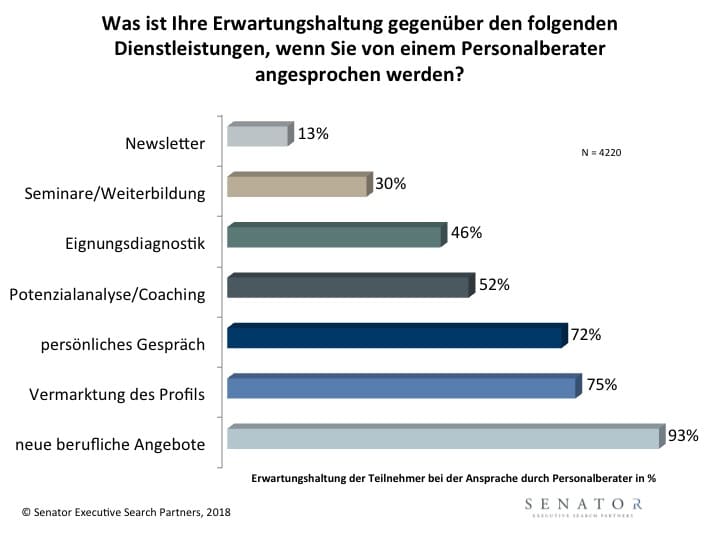
Anyone wishing to offer their candidates particularly high-quality services should have a thorough understanding of the target group’s needs and preferences and tailor their offering accordingly. To help with this, the recruitment experts at HR Consult Group AG conducted a candidate survey – to which more than 10,000 people responded – to investigate, amongst other things, which benefits candidates value most highly.
The top responses come as no surprise: at 93 per cent, almost all candidates expect to receive new job offers from recruitment consultants. Three-quarters of those surveyed expect their profile to be actively marketed by the recruitment agency and put forward to potential employers. A similar proportion of participants – 72 per cent – regard a face-to-face meeting with a consultant as an integral part of the process. The main focus here is on personalised service and building a relationship of trust.
More than half expect an aptitude assessment / a potential analysis
In fourth and fifth place in the ranking are coaching sessions and a potential analysis, accounting for a total of 52 per cent, and aptitude assessment procedures, accounting for 46 per cent. Both methods aim to identify the candidate’s strengths and weaknesses, thereby potentially uncovering entirely new professional focuses and career prospects.
„Candidates“ main expectations of a recruitment consultancy are quite clear. We are expected to help them find a job, and that is, of course, precisely our role. What is interesting, however, is that the survey respondents clearly attach great importance to a personal and individual dialogue. As recruitment consultants, we very much welcome this, as this direct and personal connection allows wishes and goals to be defined more quickly, effectively and clearly. Combined with the analytical tools at our disposal, this enables us to find the right role and the right employer for each candidate very efficiently and with great precision,” explains Mr Lars Osmers, recruitment consultant at SENATOR.
As part of aptitude testing, many personality traits are assessed. The so-called key criteria are particularly important in this context.
The question often arises as to which criteria a candidate must absolutely meet in order to successfully fulfil the requirements of a role. Or which personality traits are decisive in determining whether a job holder will succeed or fail. The key criteria identified through aptitude testing provide the answers to these questions.
Unlike the criteria defined by line managers or HR professionals as key criteria for specific roles, the key criteria used in the aptitude assessment at HR Consult Group AG are derived from the most significant characteristics of the relevant reference group.
The 10 key criteria of a standard or best-practice profile are derived from the group’s own findings. These are the criteria that show the least variation. This is where the degree of agreement is highest.
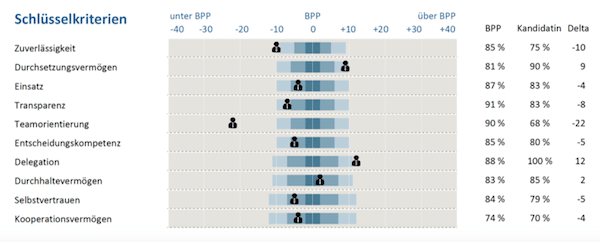
The analyses of the test results for the various characteristics each show different degrees of variation (see the sample analysis above); in other words, the range of test results varies from one characteristic to another. This is because the test subjects in a comparison group assess the individual characteristics differently.
The key factor here is that the range or variation of this characteristic is very narrow; in other words, the test subject forms an almost identical assessment of this topic and thus agrees with the comparison group that this characteristic, in precisely this form, is significant for this occupational group. Consequently, personality traits exhibiting the lowest variation or range become the key criterion for the respective position- or occupation-specific standard or best-practice group.
Key criteria therefore have the highest significance. These are assessed on the basis of the standard deviations. If the standard deviation is low, the variation caused by the results of the various tests is also low. This means that the values are closer to the mean. The result is a narrower range and, consequently, a clearer and more significant characteristic, which is referred to as a key criterion.
If a candidate’s score falls within the colour-coded range, as shown in the example above, the candidate falls within the benchmark profile. If the score is lower – that is, to the left of the benchmark group’s range – the candidate’s self-assessment of this characteristic differs significantly from that of their benchmark group. In this case, specific questions should be asked to find out why the candidate assesses themselves in this way. This usually indicates a characteristic with potential for development.
If their result falls to the right of the colour-coded range, they rate themselves higher than the comparison group on this point, which generally does indeed reflect a strength. The percentages shown on the far right indicate the exact average for the reference group, the candidate’s score and the resulting delta – that is, the exact deviation from the reference group’s average.
The key criteria can be sorted by degree of significance. Subsequently, depending on the approach chosen, a number of criteria are selected and assessed as key criteria. Various methods are conceivable and can be implemented effectively:
On the one hand, a fixed number of criteria can be selected, e.g. the first five or ten criteria. On the other hand, a percentage can also be specified, so that, for example, 20 % of all criteria are regarded as key criteria, which exhibit the lowest degree of variation.
The key insight is that the key criteria for successfully fulfilling a role emerge naturally and do not need to be identified through laborious consultation processes with specialist departments and the HR department.
The next instalment in our series will look at the soft skills that are virtually identical across a successful professional group.
After completing his degree in Automotive Engineering and Industrial Engineering, he began his career in the automotive industry in the fields of sales, development and marketing, and also spent a year in Japan working for one of the largest automotive suppliers.
He then moved to a world-renowned premium car manufacturer, where he served as a marketing officer responsible for product marketing in Japan and South America, and as a marketing officer responsible for marketing strategy in North and South America.
In 1994, he decided to set up his own business and founded a recruitment consultancy in Munich, which he has been developing and expanding for over 20 years. As managing director, his main areas of focus are, naturally, the automotive sector and mechanical and plant engineering.
His PhD in the field of aptitude assessment perfectly complements his areas of expertise, particularly with regard to HR and management consultancy. His thesis focuses on identifying and demonstrating typical personality traits among engineers, as well as defining areas for development to ensure a successful career.
These are scientifically derived and presented in the book *Aptitude Testing in Practice*.
At the same time, his focus is on building networks and cooperation models, as well as the ongoing development of systems and processes in HR consultancy.
Over the past 20 years in the field of HR consultancy, he has developed several brands that continue to operate successfully in the market to this day.
It’s back in vogue: appreciation in corporate culture and leadership. However, it’s not just about making staff feel comfortable. Showing appreciation, even towards „hard-nosed“ colleagues, leads to greater motivation. But that’s by no means the end of the chain of positive outcomes – it’s only just begun. Those who are motivated are happy to go the extra mile. Perhaps working overtime on occasions when they would otherwise have stuck strictly to their duties. Taking fewer sick days and volunteering their time for the company. Contributing ideas rather than letting others do it for them.
Now, a boss might say that our staff have it good here. They shouldn’t complain; after all, they receive a secure salary every month. But does the workforce see it the same way? It’s worth taking a look behind the façade to see whether these well-intentioned sentiments are actually being received that way.
The reason is quite simple: we are living in an era of demographic change. The baby boomers born between 1960 and 1970 will remain in the labour market for a good 10 years yet, and many sectors are already experiencing a noticeable shortage of skilled workers. What does this have to do with appreciation? Those who are in a position to choose where they work are more likely to opt for an employer who shows their staff appreciation. Where the boss recognises their work, where they can feel the full significance of praise. Where a culture of appreciation is fostered between managers, staff and business partners. Where they look forward to walking through the company gates again on Monday morning and, on Friday afternoon, feel it’s a shame that work is now coming to a halt for the weekend. Where staff turnover is lower because people feel that the company has their best interests at heart.
No manager should assume that the corporate culture – whether „stingy“ or appreciative – goes unnoticed by the outside world. Many companies are reviewed on internet portals such as kununu.de assessed by applicants and current staff. And, particularly in a regional context, word of mouth still counts for a great deal. This gives potential employees a realistic picture of what to expect. If it’s appealing, staff will come flocking to you. If it’s off-putting, you’ll be chasing after applicants. The level of appreciation within the corporate culture is a key factor in determining which way the balance tips.
Andreas Otterbach is an expert in excellence in human resources and corporate management. His work focuses on human resources and organisational development, particularly on fostering a culture of appreciative leadership. He also supports specialists and managers through one-to-one coaching sessions.
As a professor of business administration and corporate management at the Stuttgart Media University, Andreas Otterbach’s research focuses on the factors behind the success of „hidden champions“, particularly in the area of human resources management. This research yields many insights that can also benefit small and medium-sized enterprises. His book *Führend durch Wertschätzung* (2017) provides a good insight into this topic.
Andreas Otterbach is a business trainer and systemic coach, both of which he is certified in by the German Association for Coaching and Training (DVCT). These skills enable him to work with his clients in a highly personalised and goal-oriented manner.
Further stages in his education included a degree in business administration and a PhD at the University of Bamberg. He also holds a diploma in banking and finance.
At HR Consult Group AG, Mr Otterbach leads the „Leadership through Appreciation“ division. Drawing on research into „hidden champions“, he supports companies and their managers in implementing an appreciative corporate and leadership culture. This group of ‘small global market leaders’ demonstrates exceptional characteristics in these key areas, which have also led to extraordinary business success. And our clients benefit from this knowledge!
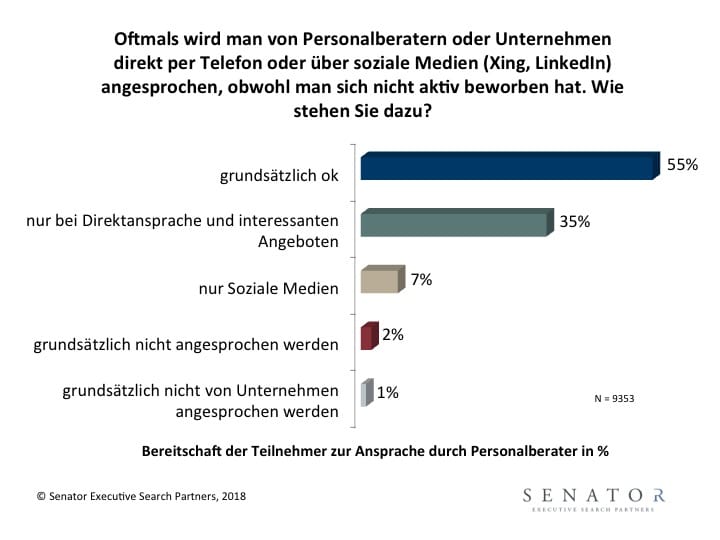
Candidates are often approached directly by recruitment consultants or companies by telephone or via professional networking sites such as Xing or LinkedIn, even without having actively applied for a role. The HR experts at HR Consult Group AG were keen to find out how candidates feel about this unsolicited contact. They investigated this topic in a survey to which more than 10,000 participants responded. The aim of the study is to get to know the candidates even better, so that recruitment consultancies can tailor their services as precisely as possible to the candidates’ wishes and needs.
The result is clear: an overwhelming majority of participants (97 per cent) agree to being contacted, even though the candidate has not actively applied for the role. Of these, 35 per cent stated that they would only wish to be contacted via direct approach in conjunction with a specific offer.
Only 7 per cent would like to be contacted exclusively via social media (e.g. Xing and LinkedIn), and a total of 3 per cent do not wish to be contacted at all.
„No prospective candidate wants to spend ages searching job boards or filling in tedious application forms dictated by applicant tracking systems. By comparison, being approached by a recruitment consultant is simple, quick and very convenient for the candidate. The recruitment consultant makes things easy for the candidate and can thus position themselves as a friendly supporter and partner. At the same time, the general willingness to change jobs is very high in the current job market, meaning that attractive offers made in person often lead to a successful placement,“ explains Mr Mirko Bahr, recruitment consultant at Senator Executive Search Partners GmbH, commenting on the survey results.
After completing his degree in Automotive Engineering and Industrial Engineering, he began his career in the automotive industry in the fields of sales, development and marketing, and also spent a year in Japan working for one of the largest automotive suppliers.
He then moved to a world-renowned premium car manufacturer, where he served as a marketing officer responsible for product marketing in Japan and South America, and as a marketing officer responsible for marketing strategy in North and South America.
In 1994, he decided to set up his own business and founded a recruitment consultancy in Munich, which he has been developing and expanding for over 20 years. As managing director, his main areas of focus are, naturally, the automotive sector and mechanical and plant engineering.
His PhD in the field of aptitude assessment perfectly complements his areas of expertise, particularly with regard to HR and management consultancy. His thesis focuses on identifying and demonstrating typical personality traits among engineers, as well as defining areas for development to ensure a successful career.
These are scientifically derived and presented in the book *Aptitude Testing in Practice*.
At the same time, his focus is on building networks and cooperation models, as well as the ongoing development of systems and processes in HR consultancy.
Over the past 20 years in the field of HR consultancy, he has developed several brands that continue to operate successfully in the market to this day.