What was previously merely a conjecture has now been confirmed by our candidates in an extensive survey: they rate their experience of working with recruitment consultancies positively overall and particularly value the advice they receive.
For our latest survey, we have compiled 38 questions on the topic of „recruitment consultancies“. The aim was to gain an up-to-date and comprehensive picture of opinions regarding the service and image of recruitment consultancies. Over 10,000 candidates took part in this survey. Furthermore, for the first time, the candidates surveyed were given the opportunity to share their wishes, ideals and personal experiences of dealing with and working alongside recruitment consultancies.
Candidates would like to receive job offers at least once a month
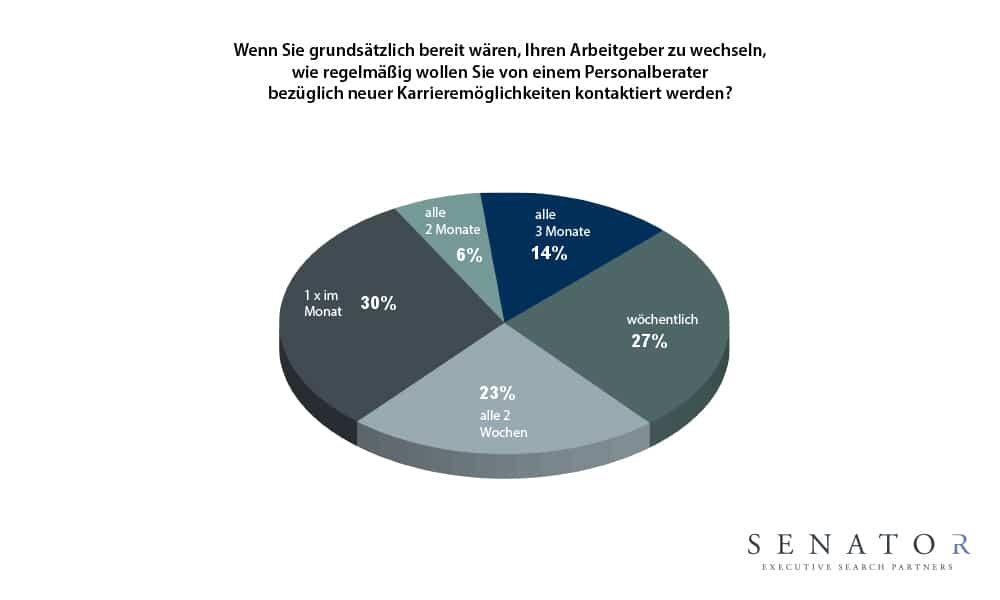
At 80 per cent, the vast majority of survey respondents would like to be informed by a recruitment consultant about new vacancies and career opportunities at least once a month or more frequently. More than a quarter of all respondents (27 per cent) would like quite intensive support (weekly contact), whilst for 23 per cent of respondents, receiving information every two weeks is sufficient. Just under a third (30 per cent) of all respondents would like to be informed by their recruitment consultant about new career opportunities once a month.
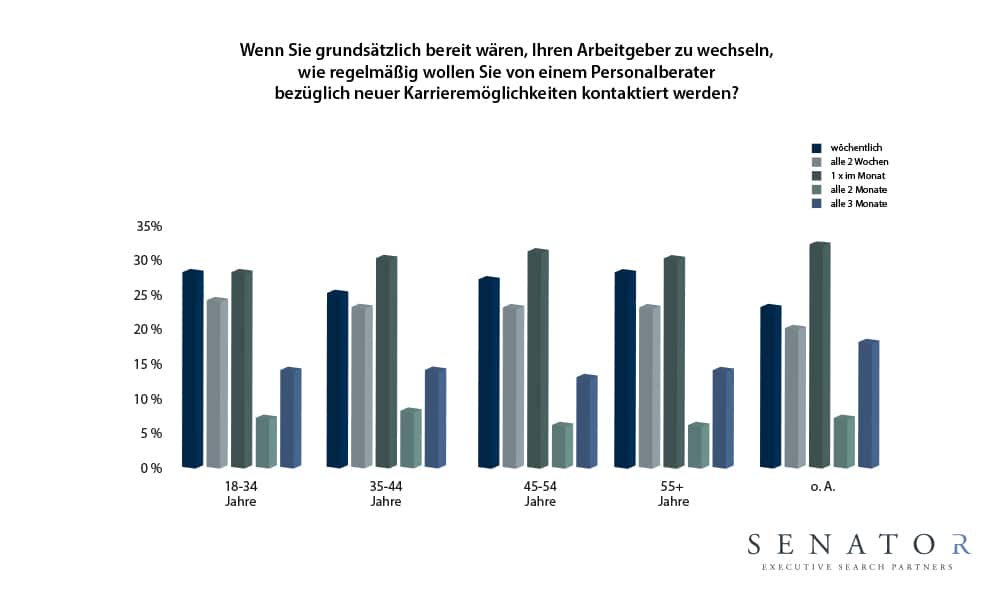
This preference is also confirmed when the data is analysed in more detail by age group: across all the age groups analysed, a monthly frequency was most frequently cited as the preferred option, followed by a weekly information service.
Our survey on the topic of „recruitment consultancy“ is still ongoing. As well as the frequency of contact, it is also important to know which channels can be used to reach our candidates and at what times. More on this in the next blog post!
After completing his degree in Automotive Engineering and Industrial Engineering, he began his career in the automotive industry in the fields of sales, development and marketing, and also spent a year in Japan working for one of the largest automotive suppliers.
He then moved to a world-renowned premium car manufacturer, where he served as a marketing officer responsible for product marketing in Japan and South America, and as a marketing officer responsible for marketing strategy in North and South America.
In 1994, he decided to set up his own business and founded a recruitment consultancy in Munich, which he has been developing and expanding for over 20 years. As managing director, his main areas of focus are, naturally, the automotive sector and mechanical and plant engineering.
His PhD in the field of aptitude assessment perfectly complements his areas of expertise, particularly with regard to HR and management consultancy. His thesis focuses on identifying and demonstrating typical personality traits among engineers, as well as defining areas for development to ensure a successful career.
These are scientifically derived and presented in the book *Aptitude Testing in Practice*.
At the same time, his focus is on building networks and cooperation models, as well as the ongoing development of systems and processes in HR consultancy.
Over the past 20 years in the field of HR consultancy, he has developed several brands that continue to operate successfully in the market to this day.
What was previously merely a conjecture has now been confirmed by our candidates in an extensive survey: they rate their experience of working with recruitment consultancies positively overall and particularly value the advice they receive.
For our latest survey, we have compiled 38 questions on the topic of „recruitment consultancies“. The aim was to gain an up-to-date and comprehensive picture of opinions regarding the service and image of recruitment consultancies. Over 10,000 candidates took part in this survey. Furthermore, for the first time, the candidates surveyed were given the opportunity to share their wishes, ideals and personal experiences of dealing with and working alongside recruitment consultancies.
Email remains the top communication channel
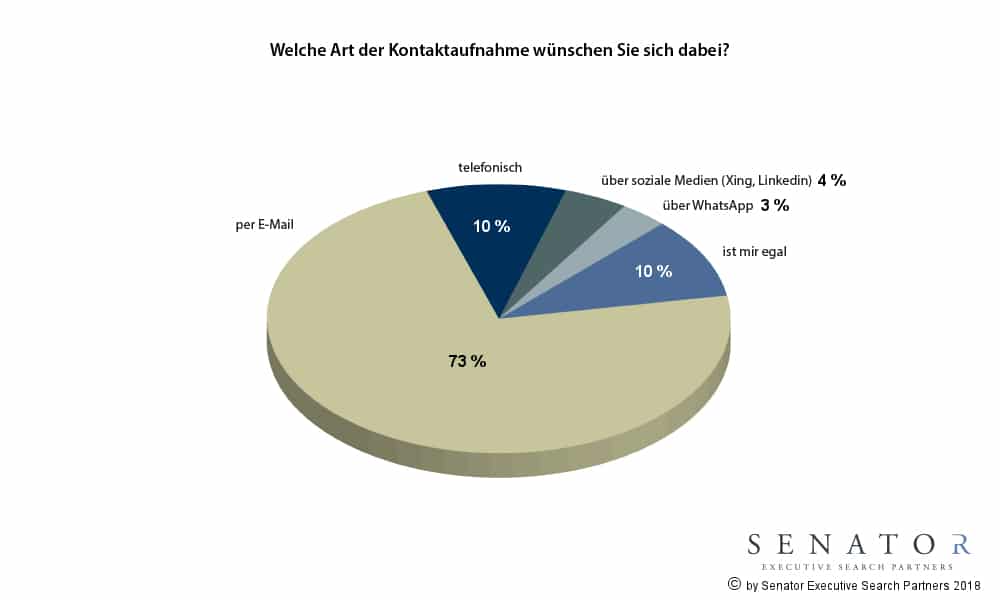
With more than two-thirds (67 per cent), the vast majority of respondents prefer to be contacted by their recruitment consultant via email. A further 10 per cent of candidates would still like to be contacted by telephone. An equal number of candidates do not prefer any of the communication channels on offer. Only 4 per cent and 3 per cent respectively of those surveyed would like to receive messages from their recruitment consultant via professional social networks or via WhatsApp.
Candidates’ preferred methods of communication
The right time is, and always will be, a matter of personal judgement
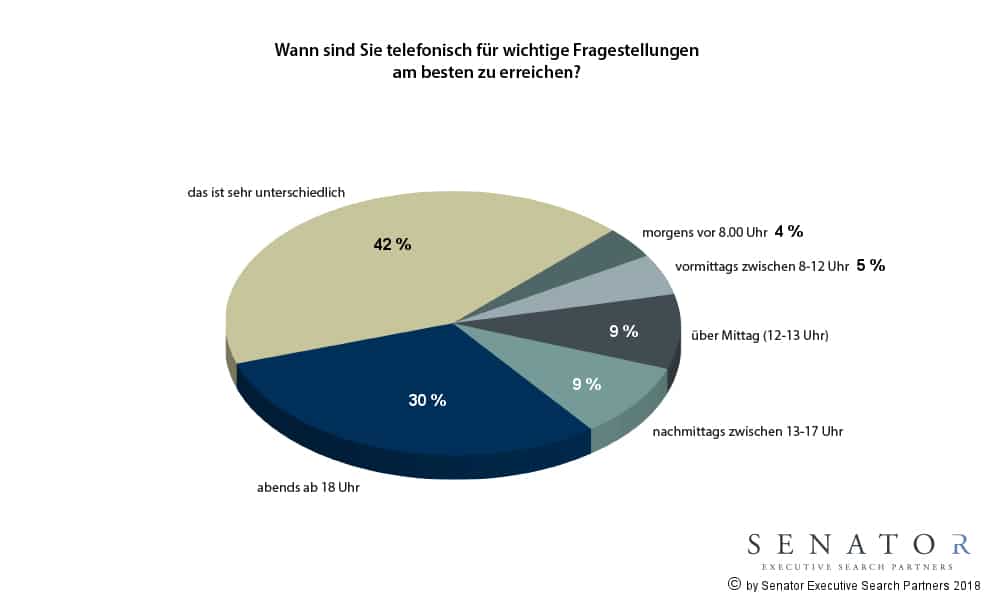
Changing jobs is often a move that shouldn’t be shouted from the rooftops. Ideally, your current employer shouldn’t find out about your job search until the new position is secured. This desire for discretion is also reflected in the responses from the candidates surveyed. 28 per cent of all respondents would prefer to be contacted by telephone only in the evening from 6 pm onwards. At 40 per cent, the majority stated that their availability by telephone varied greatly. Very few candidates prefer to be contacted by telephone from the morning (before 8 am) until the afternoon (up to 5 pm).
Preferred time to contact candidates
Mr Daniel Fertl, Head of Research at Senator HR Management GmbH, confirms that it should be clarified individually with each candidate when and how contact should be made:
„Ask each candidate right at the first interview how often and by what means they would like to be contacted if you have suitable job vacancies for them or need to clarify important matters at short notice. Too many phone calls or emails may put the candidate under pressure, whilst too little contact can quickly give the impression of negligence in your support. As a recruitment consultant, it should therefore be your top priority to find out what the candidate prefers. This will then form the basis for your future collaboration.“
After completing his degree in Automotive Engineering and Industrial Engineering, he began his career in the automotive industry in the fields of sales, development and marketing, and also spent a year in Japan working for one of the largest automotive suppliers.
He then moved to a world-renowned premium car manufacturer, where he served as a marketing officer responsible for product marketing in Japan and South America, and as a marketing officer responsible for marketing strategy in North and South America.
In 1994, he decided to set up his own business and founded a recruitment consultancy in Munich, which he has been developing and expanding for over 20 years. As managing director, his main areas of focus are, naturally, the automotive sector and mechanical and plant engineering.
His PhD in the field of aptitude assessment perfectly complements his areas of expertise, particularly with regard to HR and management consultancy. His thesis focuses on identifying and demonstrating typical personality traits among engineers, as well as defining areas for development to ensure a successful career.
These are scientifically derived and presented in the book *Aptitude Testing in Practice*.
At the same time, his focus is on building networks and cooperation models, as well as the ongoing development of systems and processes in HR consultancy.
Over the past 20 years in the field of HR consultancy, he has developed several brands that continue to operate successfully in the market to this day.
Looking for a new job is always a major life change. Some candidates look forward to this new chapter with excitement, whilst others have mixed feelings. A relationship based on trust and a close personal bond with your recruitment consultant is therefore a key factor in the job-search process. If the chemistry is right, you’re sure to find a new job quickly.
This is confirmed by the latest survey conducted by the HR Consult Group on the topic of „recruitment consultancies“, which involved over 10,000 respondents. The responses to the 38 questions provide an up-to-date and comprehensive picture of public opinion regarding the service and image of recruitment consultancies.
Reputability and trust are key factors
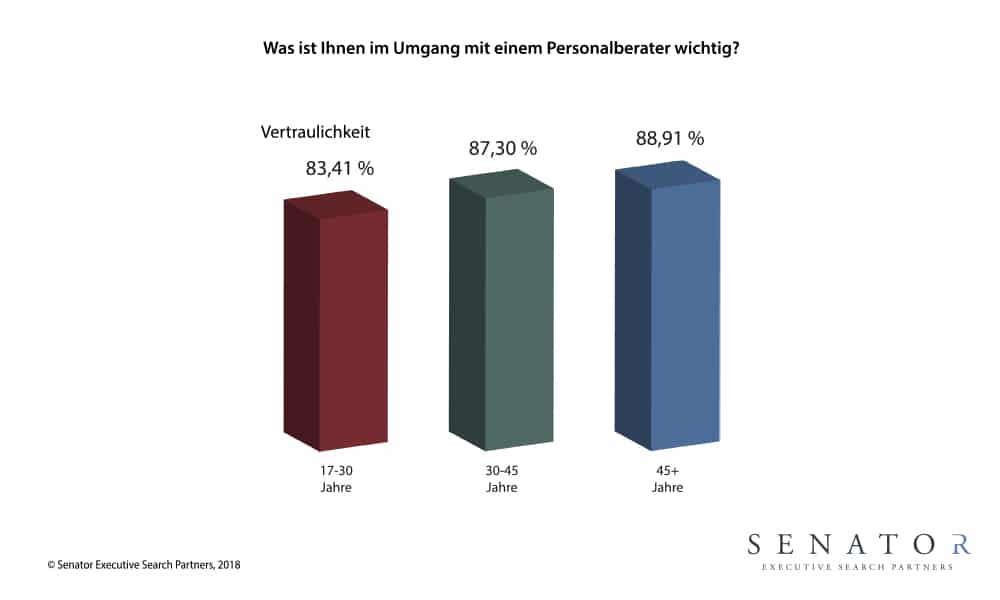
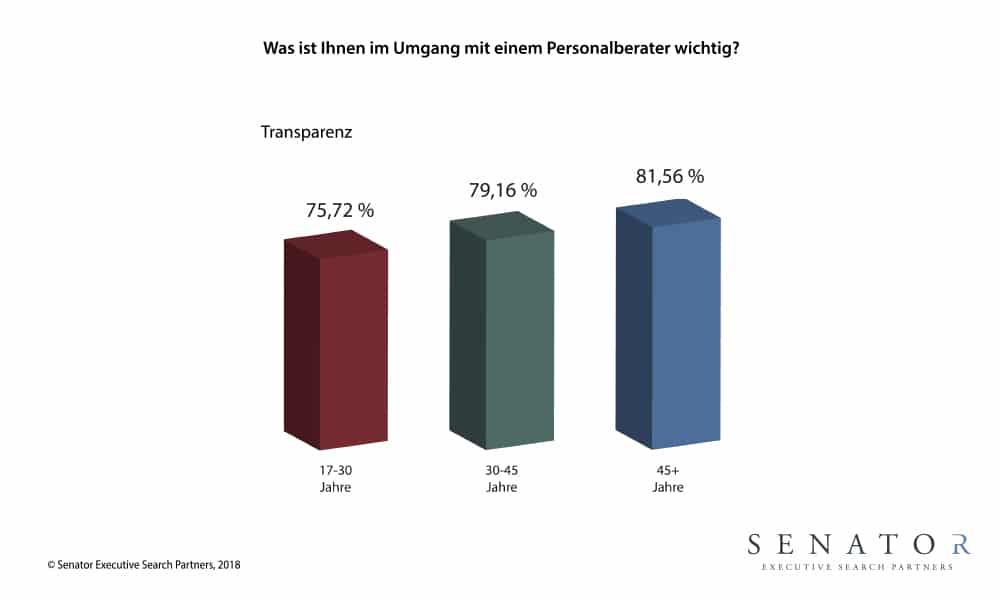
The survey results clearly confirm that a professional and trustworthy demeanour on the part of the consultant is of crucial importance. Across all age groups surveyed, more than 80 per cent of participants stated that they attach particular importance to professionalism when working with a recruitment consultant. At almost 90 per cent, the group of participants aged over 45 attaches the greatest importance to professionalism, followed by the 30 to 45 age group at 87.5 per cent and the younger age group (17 to 30 years) at around 83 per cent. A similar pattern emerges in the analysis of confidentiality and transparency. Both categories are most frequently rated as very important by older candidates.
When it comes to personalised communication, the result is also highest in the 45+ age group. Just under three-quarters of those surveyed stated that personal contact is particularly important to them. However, the remaining candidates also attach great importance to a personal approach (73.5 per cent among 30 to 45-year-olds and 70.4 per cent among 17 to 30-year-olds).
Younger and older candidates, in particular, attach great importance to a prompt placement. Among both 17- to 30-year-olds and those aged 45 and over, more than 77 per cent stated that a prompt placement was important to them. In the 30 to 45 age group, only three-quarters of those surveyed considered a swift placement to be of particular importance.
People aged 30–45 are particularly interested in exciting offers
Whilst the older group of respondents is particularly interested in issues such as reliability, confidentiality and transparency, the middle-aged group of 30- to 45-year-olds attaches particular importance to exciting offers. 84 per cent stated that receiving regular updates with exciting offers was important to them. The other two age groups are almost neck and neck in this regard (82 per cent in the 45+ age group, 81 per cent in the younger target group).
„Regardless of a candidate’s age, a professional and trusting working relationship forms the basis for a successful and satisfactory placement. It is important that jobseekers feel comfortable with the support provided by a recruitment agency and perceive it as a reliable and reputable partner. The first step in this is regular face-to-face contact. Furthermore, communication should be kept as transparent as possible so that the candidate knows exactly what happens to their data and how the placement process works in detail,“ advises Mr Andreas Berger, Partner at Senator Executive Search Partners, specialising in Consumer Goods, Digital & Online Business, and Retail & Services.
After completing his degree in Automotive Engineering and Industrial Engineering, he began his career in the automotive industry in the fields of sales, development and marketing, and also spent a year in Japan working for one of the largest automotive suppliers.
He then moved to a world-renowned premium car manufacturer, where he served as a marketing officer responsible for product marketing in Japan and South America, and as a marketing officer responsible for marketing strategy in North and South America.
In 1994, he decided to set up his own business and founded a recruitment consultancy in Munich, which he has been developing and expanding for over 20 years. As managing director, his main areas of focus are, naturally, the automotive sector and mechanical and plant engineering.
His PhD in the field of aptitude assessment perfectly complements his areas of expertise, particularly with regard to HR and management consultancy. His thesis focuses on identifying and demonstrating typical personality traits among engineers, as well as defining areas for development to ensure a successful career.
These are scientifically derived and presented in the book *Aptitude Testing in Practice*.
At the same time, his focus is on building networks and cooperation models, as well as the ongoing development of systems and processes in HR consultancy.
Over the past 20 years in the field of HR consultancy, he has developed several brands that continue to operate successfully in the market to this day.
Knowing exactly what your strengths are and having a clear idea of where you want to go in your career – for many jobseekers, this is often more of a wish than a reality. To work with candidates to identify their individual strengths and weaknesses, aspirations and career prospects, recruitment consultancies offer what are known as aptitude assessments in such cases.
The latest survey by HR Consult Group AG on the topic of „recruitment consultancies“, to which more than 10,000 participants responded, examined, amongst other things, how candidates rate such aptitude assessment procedures.
More than half of those surveyed are interested in aptitude testing
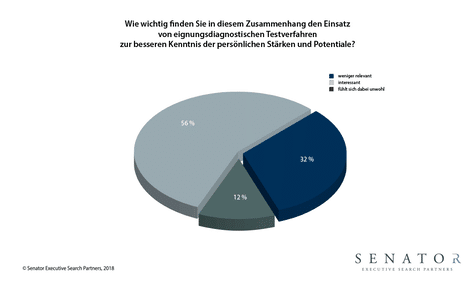
The majority (56 per cent) stated that they were interested in aptitude tests. For 32 per cent of those surveyed, this topic is of less interest, whilst only 12 per cent feel uncomfortable taking such tests.
This trend is confirmed by a detailed analysis of the findings. The results, broken down by the age of the respondents, show that the younger age group (17–30 years) displays the greatest interest in aptitude testing, at 60 per cent. Close behind are the middle age group (31–45 years), at 58 per cent, and the 45+ age group, at 54 per cent. The greatest scepticism towards aptitude testing is shown by the 45+ age group at 15 per cent, followed by the middle age group (11 per cent) and the younger age group (8 per cent).
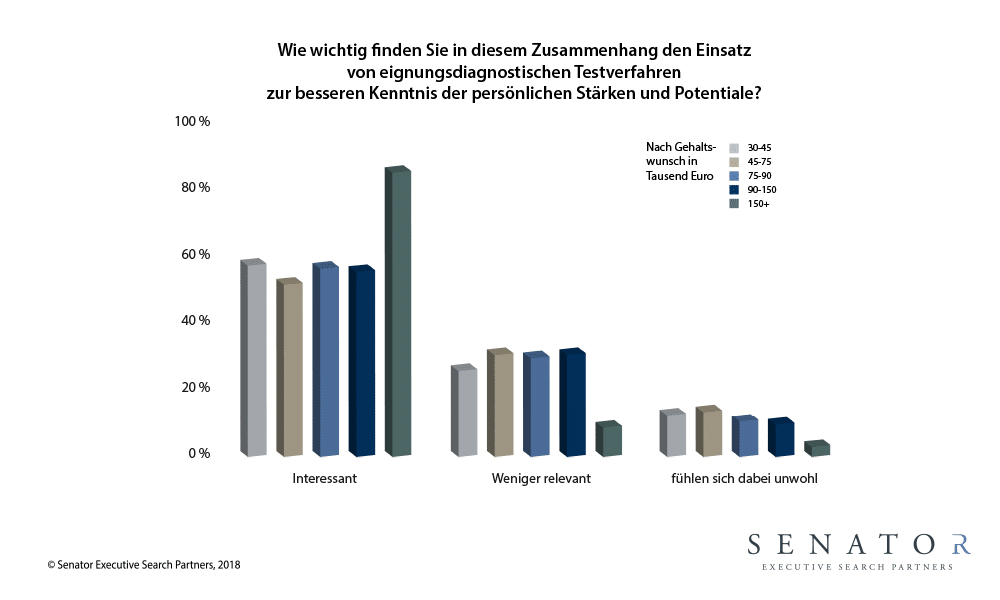
When participants are broken down by their desired salary, candidates with salary expectations of 150,000 euros or more show the greatest interest, at 89 per cent. Some way behind them comes the group with the lowest salary expectations, ranging from 30,000 to 45,000 euros, at 60 per cent. The group with a desired salary of between 45,000 and 75,000 euros showed the greatest reluctance towards aptitude testing (14 per cent).
„Aptitude assessments are a great resource for job seekers. Whether you’re just starting out in your career or looking to change career direction, the results of these assessments help to highlight a candidate’s individual strengths and thus identify the best career opportunities. My many years“ experience as a recruitment consultant show that these assessments ultimately not only increase the chances of success, but also save time and spare people a lot of stress,” he reports Mr Daniel Fertl, recruitment consultant at SENATOR.
After completing his degree in Automotive Engineering and Industrial Engineering, he began his career in the automotive industry in the fields of sales, development and marketing, and also spent a year in Japan working for one of the largest automotive suppliers.
He then moved to a world-renowned premium car manufacturer, where he served as a marketing officer responsible for product marketing in Japan and South America, and as a marketing officer responsible for marketing strategy in North and South America.
In 1994, he decided to set up his own business and founded a recruitment consultancy in Munich, which he has been developing and expanding for over 20 years. As managing director, his main areas of focus are, naturally, the automotive sector and mechanical and plant engineering.
His PhD in the field of aptitude assessment perfectly complements his areas of expertise, particularly with regard to HR and management consultancy. His thesis focuses on identifying and demonstrating typical personality traits among engineers, as well as defining areas for development to ensure a successful career.
These are scientifically derived and presented in the book *Aptitude Testing in Practice*.
At the same time, his focus is on building networks and cooperation models, as well as the ongoing development of systems and processes in HR consultancy.
Over the past 20 years in the field of HR consultancy, he has developed several brands that continue to operate successfully in the market to this day.
It is now largely undisputed that companies must have a compliance management system in place. The key issue in this context is the nature and scope of the compliance function.
In principle, the objectives of a compliance function within a company are clearly defined: on the one hand, the aim is to prevent compliance breaches (arising from within the company) in order to avert damage (both financial and reputational) to the company. On the other hand, the compliance function is also intended to minimise, if not entirely prevent, the personal liability – under criminal and civil law – of management.
Ever since the issue of compliance has attracted significant media attention and numerous corporate scandals have come more firmly to the attention of an increasingly critical public, the question of establishing and implementing compliance management systems (CMS) has also been discussed in circles that had not previously felt it concerned them.
Risk landscape and risk strategy
Every company – regardless of sector, products or business model – faces risks that may materialise and thereby cause damage to the company. In the wake of globalisation and internationalisation, regulatory requirements have increased. Some sectors are particularly affected by this. One example is the energy sector, which is grappling with a flood of new legislation in the context of significant market changes. However, the proliferation of regulations within companies, particularly within corporate groups, is also steadily increasing, meaning that an ever-greater number of internal guidelines must be observed.
As the number of regulations increases, so does the risk that unwittinglyto breach statutory, regulatory and internal requirements. This does not affect cases of wilful breach.
Not every risk has critical or existential consequences should it materialise. Against this background, defining the risk landscape and the risk strategy form an essential basis for the future structure of the compliance management system. The first step is to identify the risks; this establishes the risk landscape (which risks exist in which business context). The second step involves assessing the risks by quantifying potential losses and estimating the probability of occurrence. In a third step, the risks are prioritised and assigned to a strategic approach (as a rule, risk strategy distinguishes between risk avoidance, risk minimisation, risk transfer and risk retention). Low-risk events are often borne by the company itself, whilst risks involving high losses are transferred to third parties (e.g. insurance). In the case of non-transferable risks, the company attempts to minimise or even avoid them through appropriate measures.
Obligation to establish a compliance function
Every manager would be well advised to protect their company – and themselves – against the risks arising from compliance breaches. This is usually achieved through a specific compliance management system (CMS). To what extent, however, is there an obligation to establish such a compliance function?
Opinions on this matter are far from unanimous. Explicit legal obligations exist only in specific cases, such as Section 33 of the WpHG[1] and Section 25a of the German Banking Act (KWG)[2]. The provisions referred to expressly require the establishment of compliance functions; this applies to companies that provide investment services or financial services.
Supporters assume that there is a general obligation to establish a compliance function. This follows from a holistic interpretation of existing statutory provisions such as Sections 76, 91(2) and 93(1) of the German Stock Corporation Act (AktG) and Sections 35, 41, 43 and 85 of the German Limited Liability Companies Act (GmbHG) (statutory management function).[3].
It also follows from the provisions of the OWiG (Sections 3, 9 and 130 OWiG) that itself derive an obligation to establish a compliance function[4].
Finally, the German Corporate Governance Code (DCGK) that the Executive Board must ensure compliance with statutory provisions and the company’s internal guidelines, and must work to ensure that the group companies adhere to them[5].
Critics do not share this view. Their main argument is that – apart from the aforementioned provisions of the WpHG and KWG, and, in addition, the provision in Section 64a of the VAG[6] – there are no explicit statutory provisions. If the legislator had intended compliance functions, of whatever kind, to be mandatory, it would have included this in the relevant statutory provisions.
The interpretation of the AktG and the GmbHG as implying an obligation to establish a compliance function is also regarded as excessive.
Finally, the DCGK is also rejected as a legal basis, as it is merely advisory in nature and is therefore not legally binding. Furthermore, it applies exclusively to listed public limited companies and thus does not take all other companies into account.
All the arguments put forward are valid and well-founded. Nevertheless, they lose their impact when it comes to the question of whether members of management are willing to expose themselves to the risk of civil and criminal liability due to a lack of compliance management.
The compliance management system must be tailored to the organisation
When it comes to this question, the first thing to note is simply this: there are no specific legal or regulatory requirements for a compliance management system. In this respect, every company’s management is, in principle, free to choose the functional and organisational structures for the compliance function within their organisation. Nevertheless, there are a number of aspects which are worth considering when setting up a CMS and which may – directly or indirectly – have implications for the design of the CMS. After all, such a function ties up human and material resources and therefore represents a not inconsiderable cost factor.
The compliance function can only be truly effective if it is integrated into the overall corporate organisation as a management system. It is therefore essential to put in place a system that is appropriate for the company in question. This requires, at a minimum:
Staff allocation Responsibility for compliance must be assigned to specific individuals; in other words, responsibility in this area must be delegated to specific people. In small businesses, this responsibility may be combined with other roles (e.g. financial control), whilst large companies employ dedicated compliance officers for this purpose. Outsourcing this function to a specialist consultant is also a possibility.
Organisational integration The compliance function must be firmly embedded within the organisation. This aspect, too, depends on the size and structure of the company: in practice, all options are represented, ranging from a staff unit to a dedicated compliance department. However the compliance function is organised, it is important that it does not operate in isolation. It is essential to ensure that there is close integration with other management systems (quality management, risk management, etc.).
Definition of tasks Defining the responsibilities of the compliance function involves two aspects. On the one hand, the specific operational tasks must be set out (e.g. advising senior management and other departments within the company, developing and implementing internal policies, training staff, and monitoring for and detecting compliance breaches). Secondly, care must be taken to ensure that the responsibilities of the compliance function are suitable for ensuring that the management’s obligations (organisational, control and investigative obligations) are fulfilled – after all, this involves the delegation of supervisory duties and, in this context, the relevant interplay between the act of delegation, the selection decision and the supervision of the delegate.
Monitoring, control and reporting A compliance function requires monitoring and control. This is usually achieved through a reporting system, which, in its broader context, also includes the conduct of internal and external audits.
The CMS must be tailored to the individual company, taking into account its specific requirements and concerns, as well as its unique risk profile. In this respect, it is essential to carry out a thorough analysis of the key parameters before establishing or expanding a CMS.
[1] In Section 33 of the Securities Trading Act (WpHG), the legislator has imposed specific organisational obligations on securities trading firms (establishment of an independent compliance function)
[2] Section 25a of the German Banking Act (KWG): An institution must have a proper organisational structure that ensures compliance with the statutory provisions applicable to the institution and meets its business requirements (extract)
[3] Section 91(2) of the AktG (German Stock Corporation Act), for example, stipulates that the management board must take appropriate measures, in particular by establishing a monitoring system. The same applies to a GmbH.
[4] Under Section 9 of the OWiG (Administrative Offences Act), „ownership“ of the undertaking within the meaning of the OWiG is attributed to the persons acting directly. In practice, therefore, liability for organisational negligence under the OWiG does not lie with the company itself, but with its management.
[5] Section 4.1.3 of the DCGK (German Corporate Governance Code)
[6] Section 64 of the Insurance Supervision Act (VAG) is not relevant here
The second blog post will examine business practice and the resulting requirements.
Eckart Achauer studied law and business administration, followed by postgraduate studies leading to a Master of Business Administration (MBA). He undertook further professional development alongside his work to qualify as a European Quality Manager (DGQ), a mediator specialising in commercial mediation, and a Certified Compliance Manager (TÜV).
He spent around 10 years in the international insurance industry, holding various management positions within a Swiss insurance group (claims department, sales, assistance), before moving into management and business consultancy in 1997.
As a consultant and managing director of various consultancy firms, Mr Achauer has specialised in organisational and process optimisation, as well as in the development and implementation of management systems – quality management, risk management and compliance management.
At Senator Executive Search Partners, Mr Achauer is responsible for the Compliance Management division. As part of compliance audits, he analyses organisations„ “compliance fitness’, raises awareness and provides training for management, executives and staff, and supports companies in developing and implementing bespoke compliance management systems. In doing so, he always takes into account the specific risk profile of each company. Thanks to his many years’ experience as a manager and consultant, he is thoroughly familiar with the practical challenges faced by businesses.